How to Turn Website Traffic Into Leads: A Conversion Rate Optimization Guide for 2026

Introduction
Most businesses treat their website like a brochure. They spend thousands getting people to visit it. Then they cross their fingers.
That approach made more sense fifteen years ago when website competition was lower and users were more patient. In 2026, with ad costs rising, organic traffic harder to earn, and attention spans shorter than ever, that mindset is genuinely expensive.
The average website converts between 2 and 3 percent of its visitors. That means for every hundred people who land on your site, roughly ninety-seven leave without taking any action. If your paid ads cost you five thousand dollars a month to drive traffic, you are potentially getting back results from only three percent of that investment at best.
Conversion Rate Optimization (CRO) is the discipline of fixing that problem systematically. Instead of spending more on traffic, you figure out why the traffic you already have is not converting, then you make targeted changes to improve it.
This guide walks through what CRO actually involves, why it matters more in 2026 than any previous year, and what specific steps businesses can take to start improving their conversion rates today.
What Is Conversion Rate Optimization?
Conversion Rate Optimization is the process of increasing the percentage of website visitors who complete a desired action. Depending on your business, that action might be filling out a contact form, booking a consultation call, requesting a demo, making a purchase, or signing up for a newsletter.
The math behind it is straightforward. Your conversion rate is your number of conversions divided by total visitors, multiplied by one hundred. If your website gets a thousand visitors a month and forty of them fill out your contact form, your conversion rate is four percent.
The power of CRO comes from what happens when you improve that number. Going from a two percent to a four percent conversion rate with the same traffic effectively doubles your leads, without spending a single additional dollar on advertising. The same budget that was producing ten leads per month now produces twenty.
For businesses that rely on paid traffic especially, this compounding effect is enormous. When your conversion rate goes up, your cost per lead goes down, your return on ad spend goes up, and your entire marketing operation becomes more profitable.
Why CRO Matters Even More in 2026
There are three specific forces in 2026 that make CRO more critical than it has been in previous years.
Paid traffic is getting more expensive. Competition for Google Ads and Meta placements continues to rise. The same budget that bought a thousand clicks two years ago may buy six hundred today. When your traffic costs more to acquire, every visitor who leaves without converting represents a higher dollar loss. Improving your conversion rate directly offsets rising acquisition costs.
AI Overviews are reducing organic click-through rates. As Google shows more AI-generated summaries at the top of search results, fewer users click through to websites at all. The traffic you do earn from organic search is increasingly composed of higher-intent users who want specific answers. That makes it even more important that your website delivers immediately on their expectations when they arrive.
Buyers are more skeptical and less patient. Research consistently shows that users form an impression of a website within the first few seconds of landing on it. If a page loads slowly, looks cluttered, or fails to immediately communicate what the business does and why it is the right choice, users leave. In a market where every competitor is one click away, conversion-focused design is not a nice-to-have.
The Most Common Reasons Websites Fail to Convert
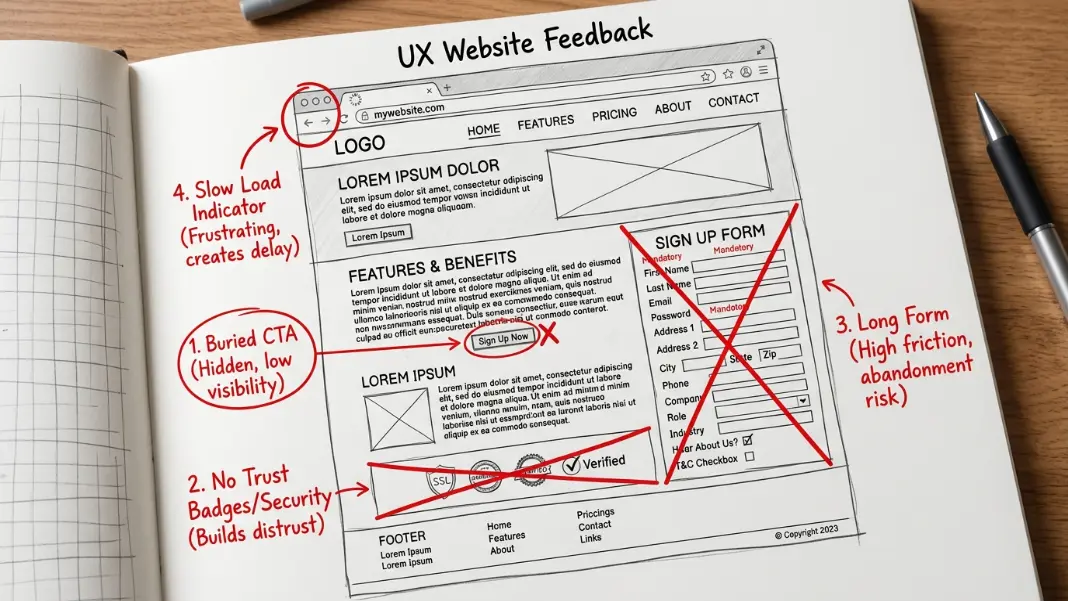
Before jumping into solutions, it helps to understand why most business websites underperform on conversions. The reasons are more predictable than people expect.
Unclear value proposition. Many websites assume visitors already know what the business does, why it is different, and why they should choose it. They do not. Your homepage and key landing pages need to answer three questions within the first few seconds: What do you do? Who do you do it for? Why should someone choose you over alternatives?
Weak or buried calls to action. A call to action (CTA) is the prompt you give visitors to take the next step. Many websites either bury their CTAs below the fold, use passive language like "Learn More," or have so many CTAs on a single page that users do not know where to click. Every page should have one primary CTA that is impossible to miss.
Slow page load speeds. Research consistently shows that users abandon pages that take more than three seconds to load. For every second of additional load time beyond that, conversion rates drop measurably. This is a technical problem that many businesses ignore because it requires developer attention, but it is often the single biggest conversion lever available.
Lack of trust signals. People do not fill out contact forms or make purchases on websites they do not trust. Reviews, client logos, case study results, professional certifications, real team photos, and transparent pricing all contribute to trust. A website that is missing these signals loses conversions to competitors who have them.
Misalignment between ads and landing pages. When a user clicks a Google Ad that promises a specific outcome, then lands on a generic homepage that does not reference that promise at all, the cognitive disconnect causes them to leave. The message of your ads and the message of the page users land on need to be consistent.
Forms that are too long or too demanding. Every additional field in a contact form reduces conversion rate. Asking for a phone number when you do not need it, requiring a budget range before you have earned that trust, or using a ten-field form for a simple inquiry all introduce friction that kills conversions.
A Practical CRO Process That Works
Effective CRO is not about randomly changing button colors and hoping for the best. It follows a structured process.
Step 1: Audit Your Current Performance
Before making any changes, you need to understand where your current visitors are dropping off. Set up Google Analytics 4 properly, with conversion events tracked for every goal. Review your most visited pages and measure their individual conversion rates. Identify the pages where traffic is highest but conversions are lowest, because those represent the biggest opportunity.
Use a heatmap tool like Hotjar or Microsoft Clarity to watch how real users interact with your key pages. See where they scroll to, what they click on, and where they stop engaging. Often, ten minutes of watching session recordings reveals problems that months of data analysis would not surface.
Step 2: Identify the Highest-Impact Problems
Not every conversion problem is worth the same effort to fix. Prioritize the changes that will affect the most visitors and address the most serious friction points. A page that gets ten thousand visitors a month with a one percent conversion rate is a much higher priority than a page getting two hundred visitors at three percent.
Common high-impact fixes include: rewriting the headline and value proposition on the homepage, adding trust signals above the fold on service pages, reducing form fields on contact pages, improving page load speed, and aligning landing page content with the ads that drive traffic to it.
Step 3: Form a Hypothesis
CRO is a scientific process. For every change you make, write down the hypothesis first. "I believe changing the CTA button from "Learn More" to "Get Your Free Proposal" will increase click-through rate by fifteen percent, because it is more specific and outcome-focused."
This discipline forces clarity about what you are changing, why, and what you expect. It also makes results more interpretable after testing.
Step 4: A/B Test Your Changes
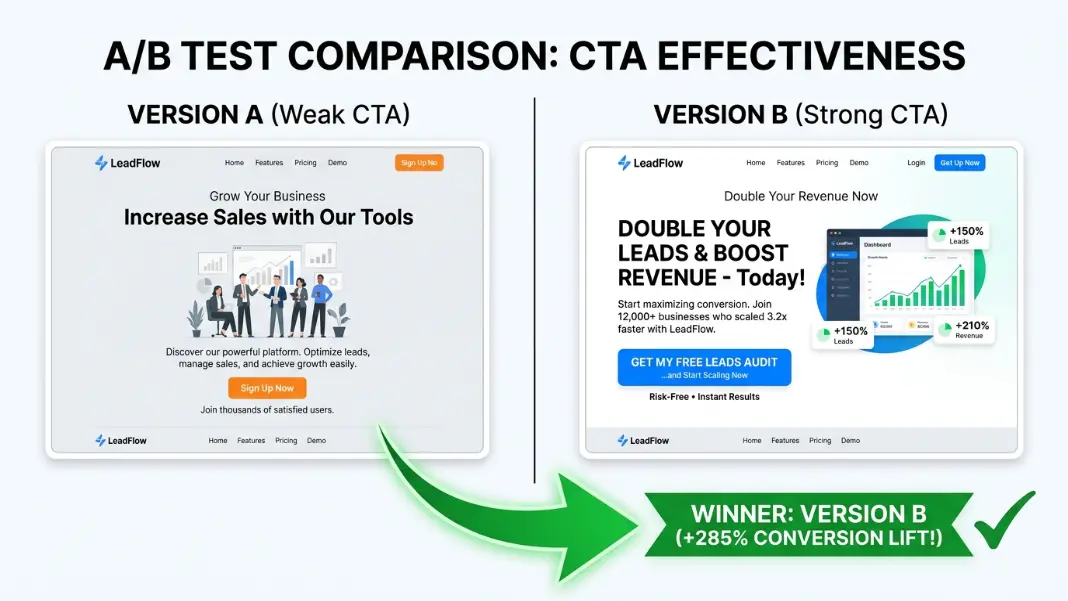
Whenever possible, test changes rather than simply implementing them. A/B testing means showing two versions of a page (the original and the variant) to different portions of your traffic simultaneously, then measuring which performs better.
Tools like Google Optimize, VWO, or Optimizely allow you to run these tests without developer involvement on most changes. The key is to run tests until you have enough data to be statistically confident in the result, typically at least two weeks and a few hundred conversions per variant.
Step 5: Implement, Measure, Repeat
When a test produces a clear winner, implement the winning version permanently. Document what you learned. Then move to the next hypothesis. CRO is a continuous improvement process, not a one-time project. The businesses that compound the most improvement are the ones that run the most structured tests over time.
High-Impact CRO Tactics for Service Businesses
Service businesses, including agencies, law firms, consultancies, healthcare providers, and home services companies, have slightly different CRO considerations than ecommerce stores. Here are the tactics that move the needle most for this type of business.
Rewrite your homepage headline. Most service business homepages lead with what the business is rather than what the client gets. "Full-Service Digital Marketing Agency" is weaker than "We Grow Your Revenue Through Search, Paid Ads, and Conversion Optimization." Lead with outcomes, not descriptions.
Add social proof everywhere that matters. This means putting a review snippet or client logo grid near your primary CTA, not hidden at the bottom of an About page. A five-star rating with a brief quote should appear on your homepage, service pages, and contact page. Case study links with specific numbers, like "+312% leads in eleven months," outperform generic testimonials.
Create dedicated landing pages for paid traffic. If you are running Google Ads or Meta campaigns, every ad should send traffic to a specific landing page that matches the ad's message, not your general homepage. Dedicated landing pages consistently outperform homepages for conversion because they are focused and eliminate distractions.
Simplify your contact process. The step from "interested visitor" to "contacted lead" should be as short and frictionless as possible. Offer multiple ways to reach you, including a contact form, phone number, and WhatsApp or live chat option. Make all of these visible without scrolling. For high-value services, consider adding a short scheduling tool so prospects can book a call directly without waiting for a reply.
Use urgency and specificity in your CTAs. "Get a Free Proposal" converts better than "Contact Us." "See How We Doubled This Client's Leads" converts better than "View Case Studies." Specificity and outcome-orientation in every prompt you give users consistently outperforms vague language.
Optimize your mobile experience. Mobile traffic represents more than sixty percent of web traffic across most industries, but mobile conversion rates consistently lag behind desktop. Your site needs to be genuinely designed for mobile, not just technically responsive. That means large tap targets, minimal form fields, fast load times on mobile data connections, and CTAs that appear above the fold on a phone screen.
CRO and Paid Advertising: The Connection Most Businesses Miss
Many businesses spend heavily on Google Ads or Meta advertising, see a poor return, and conclude that paid advertising does not work for them. In most cases, the real problem is their conversion rate.
Here is the math that makes this concrete. If your ad campaign sends a thousand visitors to your site each month at a cost of three dollars per click, that is a three thousand dollar monthly budget. At a one percent conversion rate, you get ten leads. Your cost per lead is three hundred dollars.
Now imagine CRO work lifts your conversion rate to three percent. The same three thousand dollar budget now produces thirty leads. Your cost per lead drops to one hundred dollars. The advertising campaign went from borderline unsustainable to highly profitable, and nothing about the ads themselves changed.
This is why at Nextvure, we look at conversion optimization before scaling any paid campaign. Putting more money into a leaking funnel only accelerates the leaking. Fix the funnel first, then scale.
Measuring CRO Success
Conversion rate is the headline metric, but a complete picture of CRO performance includes several related measurements.
Cost per acquisition (CPA). How much does it cost you to acquire one lead or customer? As your conversion rate improves, your CPA should decrease.
Revenue per visitor. For businesses with known deal sizes, this metric shows how much revenue each website visitor is worth on average. As conversions improve, this number rises.
Bounce rate by page. A high bounce rate on a landing page or key service page often signals a mismatch between what users expected and what they found. Tracking this alongside conversion rate tells a more complete story.
Form completion rate. If you have a multi-step contact process, tracking how many users start versus complete the form reveals specific drop-off points worth addressing.
Time to first contact. How quickly does your team respond to a new lead? Research shows that responding within five minutes of a form submission dramatically increases the likelihood of closing that lead. This is a CRO metric that lives in operations, not just the website.
Conversion Rate Benchmarks by Industry
Average conversion rates vary by industry and traffic type. These benchmarks reflect typical website-wide rates and high-performing dedicated landing pages across common service business categories.
| Industry | Average Site CVR | High-Performing CVR | Landing Page CVR |
|---|---|---|---|
| Home Services | 2.5% | 5 to 7% | 8 to 12% |
| Legal and Law Firms | 2.1% | 4 to 6% | 6 to 10% |
| Healthcare | 1.8% | 3 to 5% | 5 to 8% |
| Digital Marketing and SaaS | 2.9% | 5 to 8% | 10 to 15% |
| Financial Services | 1.6% | 3 to 4% | 4 to 7% |
| Real Estate | 2.0% | 4 to 6% | 5 to 9% |
| Restaurants and Hospitality | 3.5% | 6 to 9% | 10 to 14% |
The gap between average and high-performing rates almost always comes down to three things: a clear value proposition, prominent trust signals, and a contact process with minimal friction. If your current rate sits at or below the industry average, that gap represents direct revenue left on the table.
Conclusion
The businesses that grow most efficiently in 2026 are not necessarily the ones spending the most on traffic. They are the ones getting the most out of the traffic they already have.
Conversion Rate Optimization is one of the highest-return investments a business can make in its digital marketing. When you improve your conversion rate, every other marketing channel you run becomes more profitable. Your paid ads perform better. Your SEO investment produces more leads. Your email campaigns generate more revenue.
The good news is you do not need a massive budget to start. You need a structured process, the right data, and a commitment to testing and iterating. Start with an honest audit of where your current visitors are dropping off. Address the most obvious friction points first. Build the habit of testing and measuring every change.
If you want expert help building and running a conversion optimization program, Nextvure's CRO service combines AI heatmaps, structured A/B testing, and funnel analysis into a single program focused on one outcome: more revenue from your existing traffic.
Wondering what your current conversion rate is costing you? Request a free marketing audit from Nextvure and find out exactly where your biggest opportunities are.