What Is Answer Engine Optimization (AEO) and Why Your Business Needs It in 2026

Introduction
Picture this. Someone types a question into Google, and instead of scanning ten blue links, they read a three-paragraph AI-generated answer at the top of the page. Your competitor is cited in that answer. You are not.
That is the new battlefield of digital marketing in 2026, and most businesses do not even know the fight is happening.
For the past two decades, the entire internet marketing industry centered on one goal: rank on page one of Google. The game was about keywords, backlinks, and technical SEO. And that game still matters. But something fundamental has shifted. Google AI Overviews, ChatGPT search, Perplexity, and Microsoft Copilot are now answering millions of questions before users ever click a single link.
This is where Answer Engine Optimization, or AEO, comes in.
If you want your business to stay visible as search behavior evolves, understanding and implementing AEO is no longer optional. This guide breaks down exactly what AEO is, how it differs from traditional SEO, and what practical steps you can take to start showing up in AI-generated answers today.
What Is Answer Engine Optimization (AEO)?
Answer Engine Optimization is the practice of structuring your website content so that AI-powered search engines can easily extract, understand, and cite it in generated responses.
Traditional SEO tries to get your page ranked in a list of results. AEO tries to get your brand mentioned inside the answer itself.
Think about how you used to search for something like "best digital marketing agency for small businesses." You would scroll through several results, click a few links, compare them, and eventually make a decision. Now, a large portion of those same searchers ask ChatGPT or Google Gemini the same question. The AI reads dozens of sources, synthesizes an answer, and names specific options, sometimes with brief explanations.
If your business is not set up to be recognized and cited by these AI systems, you are invisible to that entire group of searchers, regardless of how well your website ranks in traditional results.
The shift matters more than most people realize. According to research from Adobe, web traffic from generative AI platforms increased more than tenfold in the United States between mid-2024 and early 2025. That trajectory is only going upward.
AEO vs. SEO: What Is the Difference?
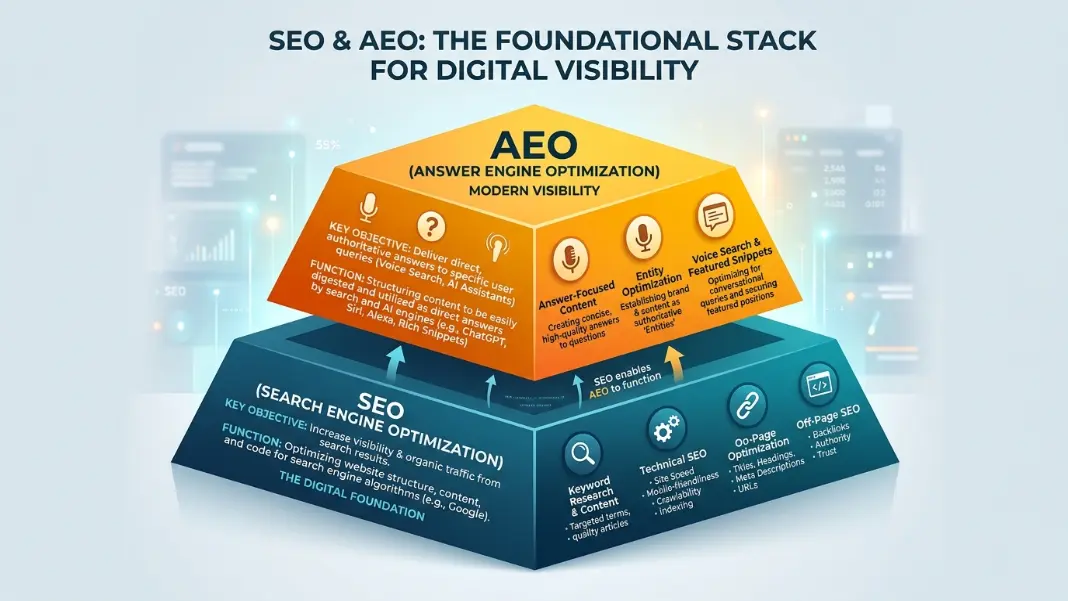
This is where a lot of confusion happens. SEO and AEO are not competing strategies. They are layered on top of each other, and you need both.
Here is how they differ in practice.
| Traditional SEO | Answer Engine Optimization (AEO) | |
|---|---|---|
| Primary goal | Rank in the top 10 results | Get cited inside AI-generated answers |
| Primary currency | Clicks and organic traffic | Brand visibility and authority |
| Key signals | Keywords, backlinks, technical SEO | Clarity, E-E-A-T, schema, question structure |
| Content format | Keyword-optimized pages | Question-focused, FAQ-structured content |
| Success metrics | Rankings, traffic, click-through rate | AI citation frequency, branded search growth |
| Works without the other | Partially | Requires SEO as its foundation |
| Typical timeline | 3 to 6 months | 3 to 6 months, compounds alongside SEO |
Traditional SEO focuses on getting your pages to rank in position one through ten on a search engine results page. Its primary currency is the click. You write content, build backlinks, optimize for technical factors, and hope users choose your link over others. Success is measured in organic traffic, rankings, and click-through rates.
AEO focuses on getting your content synthesized and cited within AI-generated answers. The primary currency is visibility and authority. You may not always get a click when an AI cites you. But your brand name appears in the answer, which builds recognition and trust. Success is measured in citation frequency, brand mentions across AI platforms, and the share of relevant AI responses that reference your business.
The most important thing to understand is that SEO is still the foundation. Without solid technical SEO, AI systems cannot even crawl and index your content. But SEO alone is no longer enough to capture the full opportunity in search.
A business that does both well will be discovered by people using Google the traditional way and by people using AI search tools. A business that does only SEO will gradually lose visibility as more users switch to AI-first search behavior.
Why AEO Matters Even More in 2026
A few years ago, this conversation was theoretical. In 2026, it is urgent.
Google AI Overviews now appear on a massive percentage of search queries. When users see an AI-generated summary at the top of a results page, many read it and stop there without scrolling further. Research consistently shows that more than half of all searches now result in no click whatsoever. That number is expected to keep climbing.
Beyond Google, consumers and B2B buyers are using ChatGPT, Perplexity, and Microsoft Copilot to research purchases, compare vendors, and make decisions. A prospect might ask ChatGPT to recommend a digital marketing agency in New York. If your agency is not structured to appear in that recommendation, a competitor takes the business.
For industries like legal, healthcare, financial services, and professional B2B services, the stakes are especially high. These are high-consideration purchases where buyers spend significant time researching before making contact. The more touchpoints they have with your brand during that research process, the more likely they are to reach out to you.
AEO gives you a seat at the table during that early research phase, even before someone visits your website.
How AI Search Engines Decide What to Cite
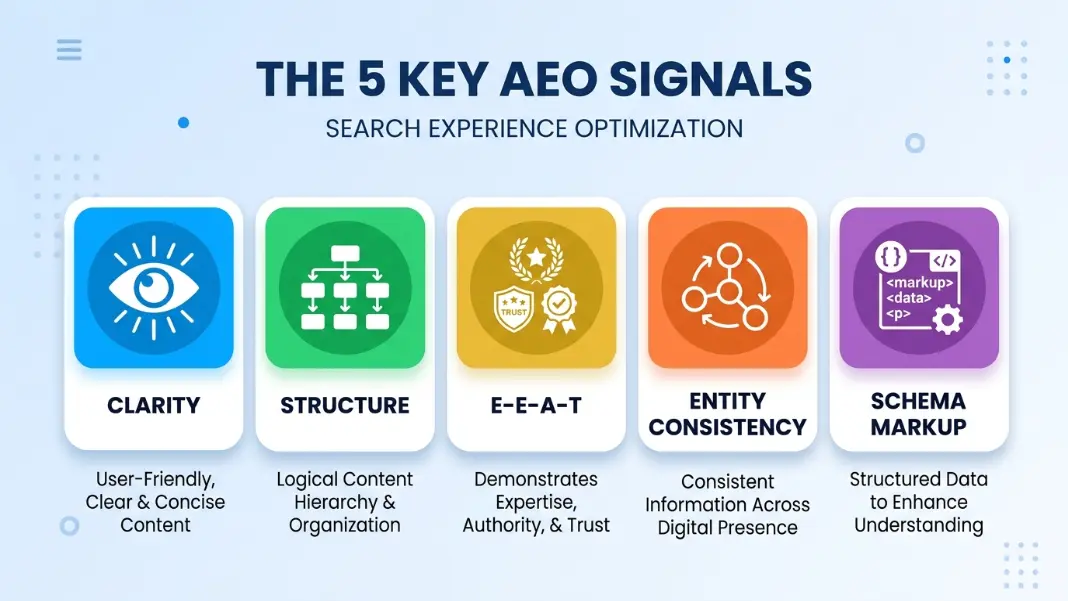
Understanding what makes content citable by AI systems is the core of AEO strategy. These systems do not operate randomly. They follow predictable patterns in selecting and referencing sources.
Clarity and directness. AI systems favor content that answers a question clearly and immediately. If someone asks "how does conversion rate optimization work," the content that starts with a direct, well-structured definition gets cited more often than content that buries the answer in five paragraphs of context.
Structured formatting. Pages with logical heading hierarchies, clear subheadings framed as questions, and organized FAQ sections give AI models easy structures to parse and extract from. Unstructured walls of text are harder for these systems to work with.
E-E-A-T signals. Google and other AI systems look heavily at Experience, Expertise, Authoritativeness, and Trustworthiness. This means author credentials, consistent brand mentions across authoritative websites, clear "About" pages, client testimonials, case studies with real numbers, and citations of credible data all contribute to how confident an AI model feels citing your content.
Entity consistency. If your business name, address, contact information, and service descriptions are inconsistent across your website, social profiles, and third-party directories, AI systems reduce their confidence in your brand. Consistency across every touchpoint is a foundational AEO requirement.
Schema markup. Adding structured data like FAQPage schema, HowTo schema, and LocalBusiness schema directly signals to search engines what questions your content answers and in what context. It is one of the most direct technical steps you can take to improve AEO performance.
Practical AEO Strategies You Can Implement Today
You do not need to rebuild your entire website to start making progress on AEO. Here are the strategies that move the needle most for business websites.
1. Write Content That Leads With the Answer
Stop burying your main point. When a potential client searches for something you can answer, give them the answer in the first two sentences, then expand with supporting detail. This mirrors how AI systems prefer to read and extract content.
For example, if you are writing a page about what a digital marketing agency does, your opening should immediately define it, not tease it with a four-paragraph story.
2. Build a Full FAQ Section on Every Key Page
FAQ sections are one of the strongest AEO signals available. They directly mirror how AI engines retrieve answers for question-based queries. On every service page and blog post, add a section with five to ten real questions your potential customers ask, followed by clear, complete answers.
Mark these up with FAQPage schema so Google and other AI systems can read them in structured format.
3. Target Question-Based Keywords
Traditional SEO often focuses on short, high-volume keywords like "digital marketing agency New York." AEO requires layering in conversational, question-based phrases like "how does a digital marketing agency help a small business" or "what should I look for in a digital marketing agency."
These longer, more natural phrases match how people speak to AI assistants. Ranking for them and answering them well increases your chances of being cited.
4. Strengthen Your E-E-A-T Signals
Create detailed author bio pages. Include case studies with specific, verifiable results. Earn mentions on recognized industry publications. Make sure your "About" page clearly establishes your team's experience and credentials.
When an AI system evaluates whether to cite you, it is essentially asking: "Is this brand trustworthy enough to recommend?" The more signals you provide, the more confident the system becomes.
5. Maintain Brand Consistency Everywhere
Your business name, description, services, and contact information should be identical across your website, Google Business Profile, LinkedIn, Clutch, G2, and any other directory where you appear. Conflicting information introduces doubt into AI confidence models.
6. Build Internal Link Structures That Signal Topical Authority
When your website covers a topic in full depth through interconnected pages, blog posts, and service descriptions, AI systems recognize you as an authority on that topic. This topical authority is different from having a single high-ranking page. It is about demonstrating depth and breadth of knowledge across a subject.
AEO for Different Business Types
AEO is not one-size-fits-all. The specific tactics that matter most depend on your industry and the type of searches your customers do.
Service businesses and agencies benefit most from FAQ content, case studies, and comparison pages that address buyer questions head-on. When a prospect asks an AI "should I hire a digital marketing agency or do it in-house," a well-written comparison page on your site could earn a citation.
Local businesses benefit significantly from combining AEO with local SEO. Google's AI systems pull heavily from Google Business Profiles, local reviews, and location-specific content when answering location-based queries. A roofing company in Chicago that has 80 five-star reviews and a well-maintained Google Business Profile has strong foundational AEO for local search.
B2B companies should focus on long-form content that answers the specific questions procurement teams and decision-makers ask during the research phase. These are people comparing vendors, justifying budgets, and evaluating risk. Content that speaks directly to those concerns gets cited and referenced.
Healthcare and legal businesses fall under what Google calls YMYL (Your Money or Your Life) categories, which means AI systems apply extra scrutiny to citations in these fields. E-E-A-T signals matter even more here. Credentials, professional affiliations, and authoritative external mentions carry significant weight.
Measuring AEO Performance
One of the real challenges with AEO in 2026 is that traditional analytics tools were not built for it. You cannot fully measure AEO success through Google Analytics alone, because many AI-driven touchpoints do not leave a click in your traffic data.
That said, there are meaningful ways to track progress.
Monitor your appearances in Google AI Overviews using tools like Semrush or BrightEdge, which now include AI Overview tracking. Track how often your brand is referenced when you search relevant questions in ChatGPT, Perplexity, and Gemini manually. Watch branded search volume in Google Search Console, as AEO success typically lifts brand searches over time as more people encounter your name in AI-generated answers. Track referral traffic from AI platforms specifically to measure direct visits from those citations.
Common AEO Mistakes to Avoid
Treating AEO as separate from SEO. These strategies reinforce each other. A website with poor technical SEO cannot be crawled and indexed properly, which means AI systems cannot read it at all. Fix your technical foundation before layering AEO tactics on top.
Writing for keywords instead of questions. If your content reads like it was written to please an algorithm rather than answer a real person's question, it will not perform well for AEO. Write naturally, focus on real value, and structure your content around the actual questions your customers ask you in sales calls and emails.
Ignoring schema markup. This is one of the most skipped steps in AEO, and also one of the highest-impact ones. FAQPage and HowTo schema are straightforward to implement and directly improve how search engines and AI systems classify your content.
Updating pages too rarely. AI systems prefer content that is current and accurate. If your blog posts reference statistics from 2022 without updates, that signals to AI systems that your content may be outdated. Build a regular review cycle into your content operation.
How Nextvure Approaches AEO
At Nextvure, we were early to recognize that SEO and AEO needed to be treated as a unified strategy, not separate services. That is why our SEO offering combines traditional search optimization with answer engine optimization from day one.
For clients like Hartley and Associates, a personal injury law firm, ranking on Google was only part of the challenge. We also built a content architecture that positioned them as the cited authority in AI-generated responses related to personal injury law in their market. The result was 900-plus keywords ranked and a tripling of inbound caseload, with traffic coming from both traditional search and AI platforms.
Every website we build is structured to perform in both search environments. Every content strategy we develop includes question-based keyword targeting, FAQ schema, and the E-E-A-T signals needed to build AI citation authority over time.
Conclusion
The way people find businesses online has changed more in the past two years than it did in the previous decade. AI-powered search is not a trend to watch. It is the current reality.
If your digital marketing strategy is still built entirely around traditional SEO rankings, you are optimizing for a search experience that a growing portion of your audience has already moved away from. AEO is how you close that gap.
The good news is that the fundamentals of great AEO are also the fundamentals of great content: be clear, be accurate, answer real questions, demonstrate real expertise. The difference is in how deliberately you structure and signal those qualities to AI systems.
Start with your existing content. Add FAQ sections. Implement schema markup. Audit your E-E-A-T signals. Build question-based content consistently. These steps compound over time, and the brands that start early build a lead that is genuinely hard for competitors to close.
If you want a team to handle this work alongside your traditional SEO, Nextvure's SEO and AEO service is built exactly for this moment.
Ready to start showing up in AI search results? Get a free proposal from Nextvure and see how we build AEO-ready content strategies for businesses across the US, Canada, and the UK.