B2B Lead Generation Strategies That Actually Work in 2026

Introduction
Every business needs leads. But most businesses are generating them the same way they did five years ago, relying on referrals, sporadic cold outreach, and hoping their website does some work on its own.
That approach still produces results for some companies. But it produces unpredictable results, and unpredictable lead flow is one of the most stressful and limiting things a business can face.
In 2026, the gap between businesses with systematic lead generation and those without has widened considerably. Rising ad costs, changing search behavior, AI-powered competition research, and smarter buyers have all made random-chance marketing increasingly expensive. The businesses growing consistently right now are treating lead generation as an engineered system, not a wishful activity.
This guide covers the B2B lead generation strategies that are actually producing results in the current environment, across both inbound and outbound approaches, and explains how to build a pipeline that does not depend entirely on whether the referral phone happens to ring this month.
What Is B2B Lead Generation?
B2B lead generation is the process of attracting and capturing interest from businesses that might become your clients or customers. A lead is a potential buyer who has expressed enough interest to provide their contact information or engage with your brand in a meaningful way.
The key distinction between B2B and B2C lead generation is the sales cycle. B2B purchases typically involve higher price points, multiple decision-makers, longer evaluation periods, and more complex requirements. Someone buying a digital marketing retainer for their company is not making an impulse decision the way a consumer buying a product online might. They are researching, comparing options, checking credentials, and often building internal consensus before signing.
This means B2B lead generation is not just about volume. It is about attracting the right buyers, at the right stage of their decision process, with the right information to build confidence and move them toward a conversation.
A lead who finds your website through a search for "how to get more leads for my law firm" and spends twelve minutes reading your case studies is a fundamentally different quality of prospect than a name on a cold email list. Both have a role in a complete lead generation system, but they require different approaches.
Why Most B2B Lead Generation Falls Short
Before outlining what works, it is worth understanding why so many lead generation efforts produce disappointing results.
Over-reliance on referrals. Referrals are the highest-quality leads a business can receive, but they are not scalable or predictable. Waiting for your network to send work is a strategy that hits a ceiling quickly. Every business that wants consistent growth needs at least one channel it can control.
Generic messaging. Many businesses describe themselves in ways that apply to every competitor in their space. "We deliver results." "We are a trusted partner." "We put clients first." These phrases tell prospects nothing specific and give them no reason to choose you. Effective lead generation requires messaging that speaks directly to a defined audience's specific problem.
Treating all channels as equal. Not every lead generation channel fits every business. A home services company and a SaaS startup have completely different buyer journeys, and the channels that work for one may be irrelevant for the other. Spreading effort across every possible channel without understanding which ones your buyers actually use produces mediocre results across the board.
No follow-up system. Research consistently shows that the majority of qualified leads do not convert on the first contact. Most require multiple touchpoints before they are ready to have a sales conversation. Businesses without a structured follow-up process leave enormous amounts of potential revenue sitting in their CRM unused.
Focusing on quantity over quality. It is very easy to generate large numbers of low-quality leads. Getting a hundred name-and-email captures from a vague lead magnet tells you almost nothing about whether any of those people are actually in a position to buy from you. A system that delivers twenty highly qualified leads per month produces dramatically better results than one that delivers two hundred weak ones.
The Two Pillars of B2B Lead Generation: Inbound and Outbound
| Channel | Speed to First Lead | Cost Level | Lead Quality | Scalability |
|---|---|---|---|---|
| SEO and Content Marketing | 3 to 6 months | Low (compounds) | Very High | Very High |
| Cold Email | Days to weeks | Very Low | Medium | Medium |
| LinkedIn Outreach | 1 to 3 weeks | Low | High | Medium |
| Google Ads (PPC) | Immediate | High | High | High |
| LinkedIn Ads | Immediate | Very High | Very High | High |
| Referrals | Unpredictable | Near zero | Highest | Very Low |
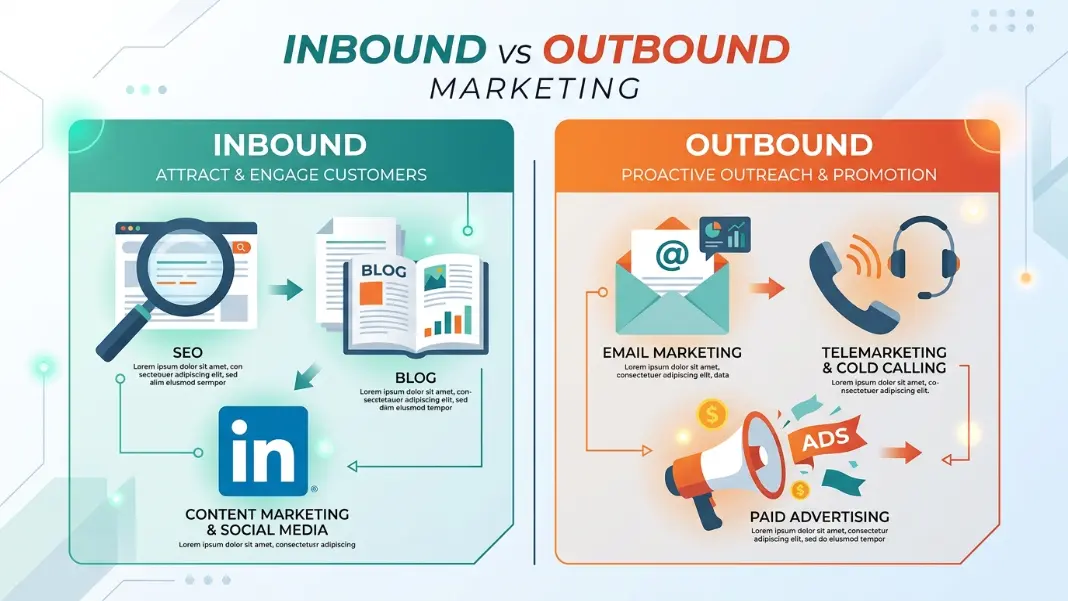
A resilient lead generation system uses both inbound and outbound strategies, with each reinforcing the other. Understanding how they differ and when each applies is the starting point for any serious lead generation program.
Inbound lead generation means creating conditions where potential buyers find you. This includes SEO, content marketing, thought leadership, social media presence, and word-of-mouth. Inbound leads arrive with built-in credibility, because they sought you out rather than being approached cold. They tend to close at higher rates and with shorter sales cycles.
The trade-off is that inbound takes time to build. SEO requires months of consistent investment before producing meaningful volume. Content authority accumulates gradually. Inbound is not the answer when you need pipeline next month.
Outbound lead generation means proactively identifying potential buyers and initiating contact. This includes cold email, LinkedIn outreach, paid advertising, direct mail, and phone prospecting. Outbound can produce results much faster than inbound and gives you more control over targeting.
The trade-off is that outbound requires stronger messaging, because you are interrupting someone who did not ask to hear from you. It also requires careful list quality and volume management to avoid being perceived as spam.
The businesses with the healthiest pipelines in 2026 are running both. They use outbound to generate leads in the short term while inbound builds and compounds over time. When inbound is working well, it reduces their dependence on outbound and lowers cost per lead dramatically.
Inbound Lead Generation Strategies That Work in 2026
SEO and Content Marketing: The Long-Term Compounder
Search engine optimization remains one of the highest-ROI lead generation channels available to B2B businesses. The reason is simple: an SEO lead comes to you already searching for what you offer. The buying intent is built in.
The keys to SEO-driven lead generation in 2026 are topical depth and intent alignment. Write content that addresses the specific questions your ideal clients search for during the research process. Not surface-level articles, but genuinely useful, detailed answers that demonstrate your expertise and help them make better decisions.
For a digital marketing agency, this means writing about specific questions business owners ask: how to choose a marketing agency, what a reasonable marketing budget looks like for their industry, how to evaluate whether their current agency is performing. These articles attract buyers who are actively considering their options.
SEO leads have historically shown a 14.6 percent close rate compared to 1.7 percent for outbound leads, according to data from HubSpot and industry benchmarks. The lead quality difference is substantial. Building a content library that earns organic search traffic is one of the highest-return long-term investments a B2B company can make.
Answer Engine Optimization: The Emerging Layer
Beyond traditional SEO, the rise of AI-powered search engines means your content also needs to be structured for citation in AI-generated answers. When a prospect asks ChatGPT to recommend a marketing agency in their industry, or asks Google what to look for in a CRO partner, your content and brand need to be positioned to appear in those answers.
This involves structuring content with clear questions and direct answers, implementing FAQ schema markup, building E-E-A-T signals consistently, and maintaining brand consistency across every platform where you appear. Businesses that layer AEO onto their SEO foundation are capturing a form of visibility that most competitors are not even thinking about yet.
LinkedIn Thought Leadership
For most B2B businesses, LinkedIn is the single best social platform for organic lead generation. Decision-makers actively use it. They engage with content from people and companies they follow. And the algorithm rewards consistent, relevant posting in ways that other platforms no longer do for organic reach.
The most effective LinkedIn approach for lead generation is not promotional. It is demonstrating genuine expertise through insights, case study summaries, lessons from client work, and honest takes on industry questions. When a marketing director who has been following your posts for three months has a problem that matches your service, you will be top of mind.
This takes consistency over time. Posting once a month produces no results. Posting three to five times per week with real substance builds a following that generates inbound inquiries predictably.
Review and Reputation Building
For B2B service businesses especially, third-party reviews on platforms like Google, Clutch, G2, and UpCity are a significant lead generation factor. Buyers research vendors on these platforms before making contact. A company with forty verified reviews and a 4.9-star average will consistently beat out a competitor with a better website but no reviews.
Building reviews does not happen by accident. It requires a systematic process of requesting reviews from satisfied clients at the right moment, making it easy for them to leave feedback on the specific platforms that matter most to your buyers.
Outbound Lead Generation Strategies That Work in 2026
Targeted Cold Email: Still One of the Best Channels
Cold email works in 2026, but it works very differently than it did five years ago. Generic sequences with templated messages produce almost no results. The bar for getting a response has risen substantially as inboxes have become more crowded.
What still works is cold email that is hyper-specific and genuinely relevant. This means doing actual research on each prospect, referencing something specific about their business, and connecting that to a concrete result you have produced for a similar client.
The best cold email format for B2B service businesses is short, specific, and proof-based. Reference a real result from a comparable client. Ask a single, relevant question. Limit the initial message to four to six sentences. The goal of the first email is not to sell anything. It is to earn a reply.
Tools that automatically scrape and send generic pitches create more harm than good in 2026. Most sophisticated buyers immediately recognize templated outreach and delete it without reading. The agencies seeing the best cold email results are sending fewer emails with significantly more personalization.
LinkedIn Outreach and Sales Navigator
LinkedIn's Sales Navigator tool allows B2B sellers to identify prospects by exact criteria, including job title, company size, industry, location, and seniority. This precision makes it possible to build highly targeted contact lists quickly.
Effective LinkedIn outreach follows a similar principle to cold email: be specific, be relevant, and lead with value rather than a pitch. Connection requests with a short, personalized note convert better than blank connection requests. Follow-up messages that reference something the prospect has posted or shared outperform generic check-in messages.
The most effective LinkedIn lead generation sequences combine a connection request, followed by a thoughtful engagement with the prospect's content, followed by a relevant and value-forward message. Building familiarity before pitching dramatically improves response rates.
Paid Search and Paid Social
Paid advertising is the fastest way to generate B2B leads when your targeting, messaging, and landing pages are aligned. Google Ads captures buyers who are actively searching for your service right now. Meta and LinkedIn ads capture buyers at an earlier stage who match your ideal client profile.
The biggest lever in paid B2B lead generation is landing page quality. An ad campaign driving traffic to a weak homepage will consistently disappoint. Purpose-built landing pages with clear value propositions, relevant social proof, and frictionless CTAs are what turn ad spend into leads.
For B2B services, Google Ads targeting high-intent keywords like "digital marketing agency for law firms" or "CRO agency for ecommerce" tends to produce higher-quality leads than broader terms, even if volume is lower. Quality over quantity is especially important when your service requires a significant sales process.
Building a Lead Generation System That Compounds
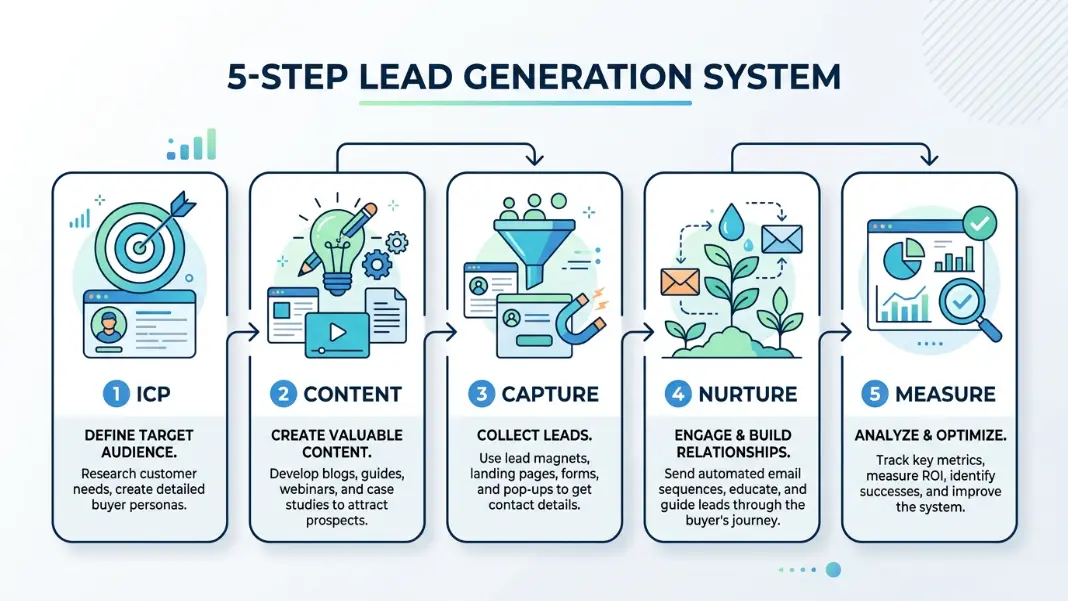
The difference between businesses that struggle with lead flow and those that do not is almost always whether lead generation is treated as a system or as a series of one-off activities.
A system has defined components that work together: a clear ideal client profile, a known set of channels, a consistent content output schedule, a structured outreach process, and a follow-up system that nurtures leads who are not ready to buy today.
Here is what a functioning B2B lead generation system looks like in practice.
Define your ideal client profile precisely. Know exactly who you want to reach: their industry, company size, title, the problems they are experiencing, and the outcomes they care about. Every piece of content you create and every outreach message you send should speak directly to this profile.
Build your authority with content. Publish consistently on the channels your ideal clients use. For most B2B businesses, this means a combination of website blog content for SEO, LinkedIn posts for awareness, and case studies for conversion.
Create a dedicated lead capture path. Make it obvious and easy for interested visitors to take the next step. A clear CTA, a specific offer (free audit, free consultation, free proposal), and a short form or booking tool removes the friction between interest and contact.
Nurture leads over time. Not every person who downloads your content or attends your webinar is ready to buy this month. An email nurture sequence that delivers genuinely useful insights over weeks and months keeps your brand relevant when they reach the stage where they are ready to have a conversation.
Measure and optimize. Track where your best leads come from. Measure the quality of leads from each channel, not just the volume. Over time, double down on what produces the highest-quality pipeline and cut what produces noise.
How Nextvure Approaches Lead Generation for Clients
At Nextvure, lead generation is not a standalone service. It is the outcome that every strategy we build is oriented around.
We combine automated outreach, AI-driven lead scoring, intent-based targeting, and content-driven inbound to build lead pipelines that are consistent and scalable. For clients like Roofline Pro, a residential roofing company with zero digital presence when we started, we built their entire lead generation foundation from scratch. The result was a 420 percent increase in annual revenue, with search becoming a consistent, predictable source of qualified jobs.
For Hartley and Associates, a personal injury law firm, we built an authority-driven SEO and content program that generated over nine hundred keyword rankings and tripled their inbound caseload. Their lead generation now runs continuously without depending on referrals or ad spend spikes.
The common thread in every successful lead generation engagement is the same: a clearly defined ideal client, a multi-channel approach with both inbound and outbound components, conversion-optimized landing pages and contact flows, and consistent measurement tied to revenue rather than vanity metrics.
Conclusion
B2B lead generation in 2026 is not about finding one magic channel. It is about building a system where multiple well-executed strategies work together to fill your pipeline with the right buyers at a volume your team can handle.
The businesses that do this well share a few things in common. They know exactly who they are trying to reach. They have content that demonstrates genuine expertise. They have outbound processes that are specific and relevant rather than generic. And they track results in terms of revenue impact, not just lead counts.
Building that system takes time and deliberate effort. But the payoff, a pipeline that grows predictably rather than ebbing and flowing with referral luck, is one of the best investments a B2B business can make.
If you want help building or accelerating your lead generation system, Nextvure's lead generation service combines automated outreach, AI-driven pipeline management, and content-driven inbound into one integrated program designed around your revenue goals.
Ready to stop waiting for referrals and start building a predictable pipeline? Get your free growth proposal from Nextvure and see exactly what a systematic lead generation program would look like for your business.