Local SEO for Plumbers: How to Rank in the Map Pack and Win Emergency Calls
Emergency Calls Go to the Plumber Google Shows First
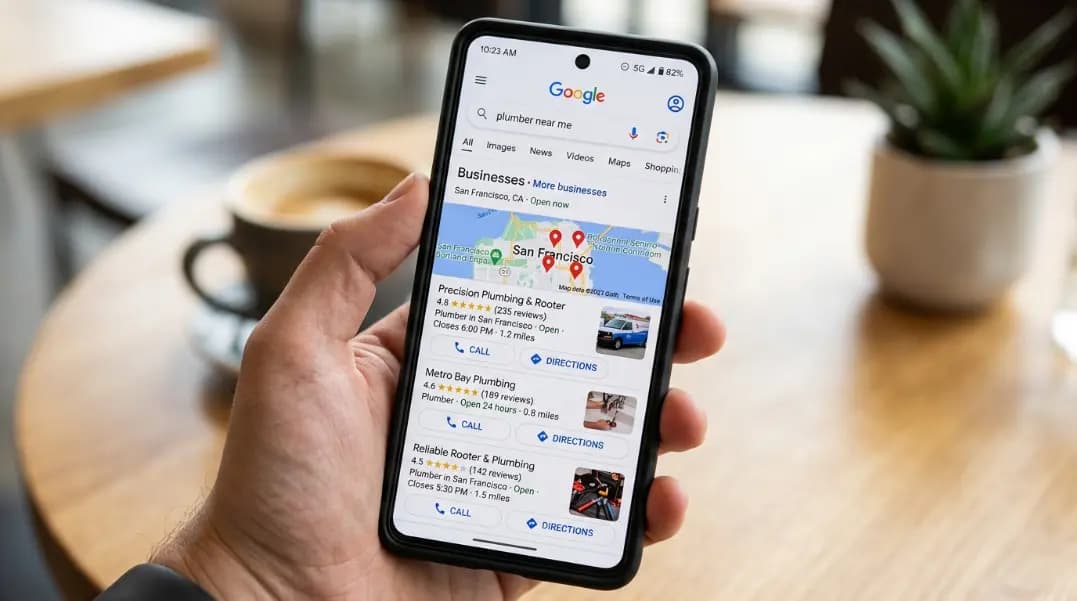
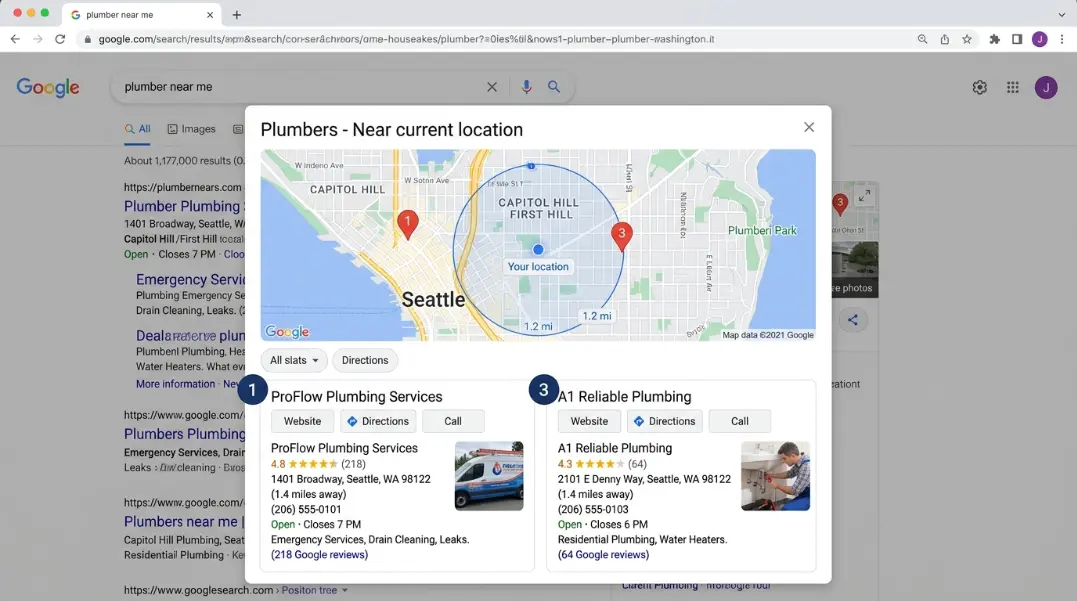
A homeowner with water rising under their kitchen sink is not reading blog posts or comparing service packages. They open Google, see three local results in the Map Pack, and call the one that has the most reviews and looks open. If that call goes to voicemail, they call the second. The job goes to whoever picks up, and the whole decision takes under four minutes.
Local SEO for plumbers is about being that first result. Not the first organic result below the Map Pack, which most customers do not scroll to during an emergency, but in the Map Pack itself. The three businesses Google displays above all other results for searches like "plumber near me" and "emergency plumber" get the majority of calls. Everyone else gets the remainder.
This guide covers how Google decides which plumbers appear in the Map Pack, what your Google Business Profile needs to be fully optimized, how citation problems silently suppress your local rankings, how reviews function as a ranking signal, and what a realistic timeline for local SEO progress looks like. For a full picture of plumbing marketing across all channels, the complete plumber marketing guide covers how local SEO fits alongside paid and other organic strategies.
Why the Map Pack Is Worth More Than Any Other Plumbing Channel
For most local plumbing searches, the Map Pack captures more calls than paid ads and organic results combined. BrightLocal research shows that the top three Map Pack listings capture 44 percent of all clicks on local service searches. On mobile, where the Map Pack takes up most of the above-the-fold view, that percentage is higher.
The economics of the Map Pack are also different from paid advertising. Google Ads for plumbers in competitive markets costs $35 to $80 per call. Once you pause spend, calls stop. Map Pack visibility, built through Google Business Profile optimization, citations, and reviews, generates calls without cost per click. A plumber ranking in Map Pack position one generates those calls continuously, whether or not they are running paid campaigns.
The investment required to get there is front-loaded: time, setup work, and a consistent review generation system. But the return compounds over time rather than stopping the moment ad spend is paused. That is why local SEO for plumbers is the highest long-term return channel in plumbing marketing, even though paid channels produce results faster in the early months.
How Does Google Decide Which Plumbers Rank in the Map Pack?
Google uses three factors to determine Map Pack rankings for local plumbing searches. Understanding each one tells you exactly where to focus your effort.
Relevance is how well your Google Business Profile matches what the searcher is looking for. A GBP with "Plumber" as the only category and no service listings is less relevant to a search for "emergency plumber" or "drain cleaning service" than a profile with "Emergency Plumber," "Drain Cleaning Service," "Water Heater Installation Service," and "Sewer Cleaning Service" all listed explicitly. Relevance is the factor you control most directly through GBP configuration.
Distance is how close your registered business location is to the searcher. You cannot change your physical location, but you can influence this factor for searches outside your immediate area through service area page strategy, which is covered below.
Prominence is how trusted and established Google believes your business to be. Prominence is determined by three things: your review count and rating, the consistency and quantity of your citations across directories, and the authority of your website. Prominence is where most plumbing companies have the most room to improve, and where the ranking gap between competitors in the same service area typically comes from.
What Does Your Google Business Profile Actually Need?
Your Google Business Profile is the single most important local ranking asset a plumbing company has. Most GBPs are set up once and left incomplete. Here is what an optimized plumbing GBP requires.
The right primary and secondary categories. "Plumber" is the standard primary category. Add secondary categories for every service you offer: "Emergency Plumber," "Drain Cleaning Service," "Water Heater Installation Service," "Sewer Cleaning Service," "Bathroom Remodeling Contractor" if applicable. Each category increases relevance for service-specific searches.
Complete and accurate business hours, including emergency hours. A plumber whose GBP shows "Closed" during an emergency call peak at 9 PM loses Map Pack visibility at the exact moment their phones should be ringing. If you offer 24-hour emergency service, that must be reflected in your hours and in your service descriptions. Google uses hour accuracy as a quality signal.
A full service list with descriptions. Use the GBP service feature to list every service individually with a brief description. "Drain cleaning" should be a named service with a 100-word description explaining what you do, not a bullet point. Each service listing increases keyword relevance for searches related to that service.
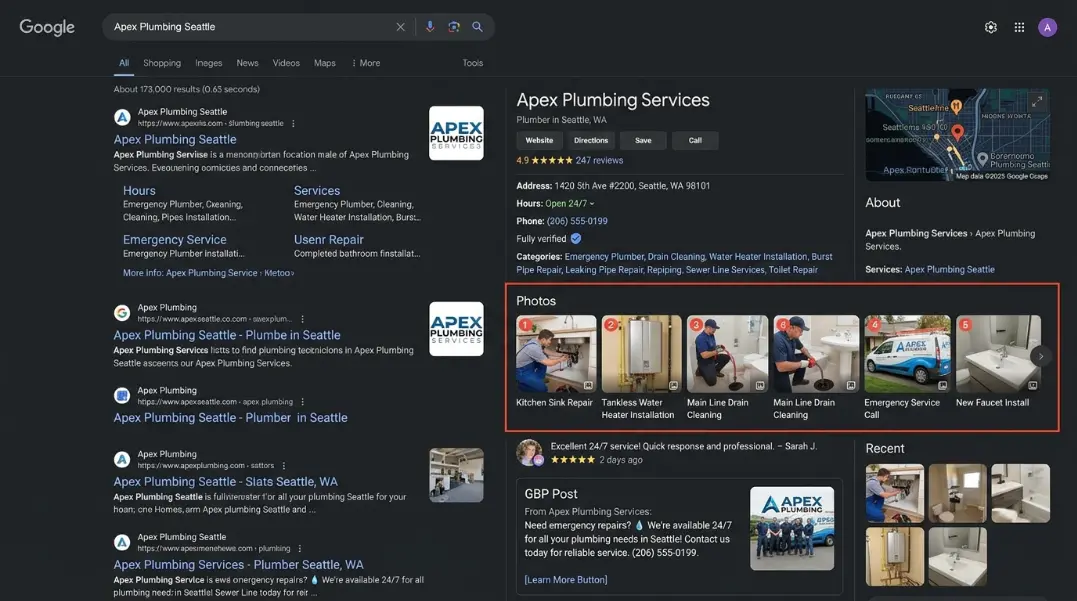
Photos from actual jobs. GBPs with regular photo uploads from real completed jobs show higher engagement rates than profiles with stock photos. Exterior van shots, job site photos, and team photos all signal an active, legitimate business. Aim for at least two new photos per month.
Regular GBP posts. Google posts on your GBP (seasonal offers, service announcements, emergency availability reminders) signal ongoing business activity. Profiles with regular posts are more likely to rank for competitive terms than profiles with no post history.
A seeded Q&A section. Add your own questions and answers to the Q&A section covering the questions customers actually ask: "Do you offer 24-hour emergency service?", "Are you licensed and insured?", "What areas do you serve?", "Do you offer free estimates?" These seed answers prevent customers or competitors from posting unmonitored content in your Q&A.
Citations: The Invisible Ranking Factor Most Plumbing Companies Ignore
A citation is any online mention of your plumbing business that includes your name, address, and phone number. Your Google Business Profile is one citation. Your Yelp listing is another. So are your listings on Angi, HomeAdvisor, Thumbtack, the Better Business Bureau, your local Chamber of Commerce, and dozens of other directories.
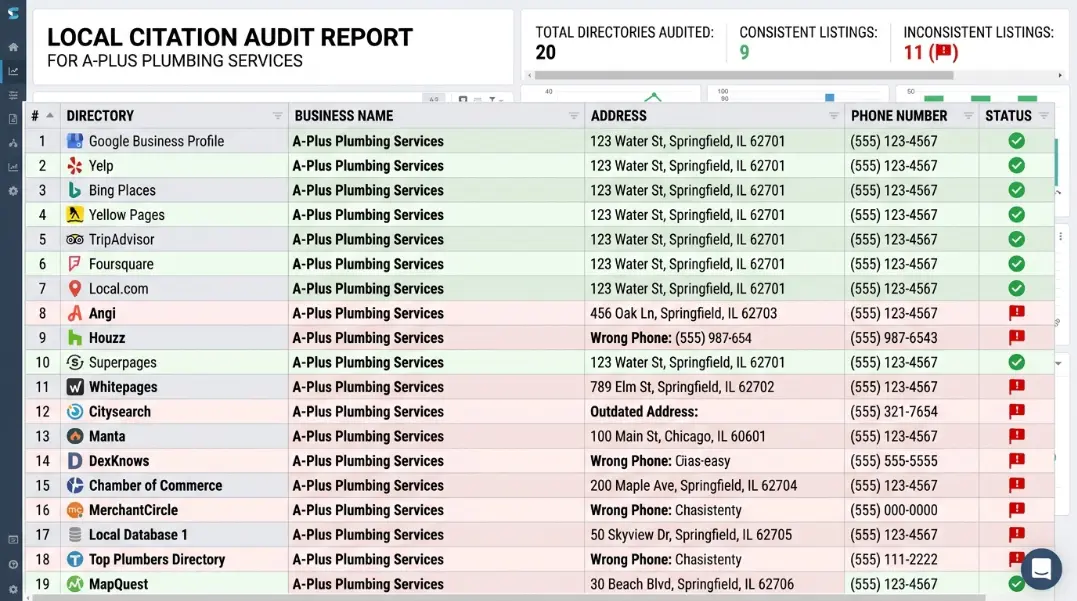
Google cross-references citations to assess how established and trustworthy your business is. A plumbing company with consistent name, address, and phone (NAP) data across 50 directories appears more established than one with inconsistent data across 15. That consistency is a prominence signal.
The problem is that most plumbing companies have citation problems they are not aware of. Phone numbers change. Addresses change. Business names get shortened or formatted differently across listings. Old listings from a previous address still exist. Each inconsistency creates a conflict in Google's understanding of your business, and Google resolves those conflicts by reducing your local visibility.
The most common citation issues for plumbing companies:
- Old phone number still listed in 20 directories after a number change
- Business name appearing as "ABC Plumbing" in some listings and "ABC Plumbing & Drain" in others
- Two separate GBP profiles from a previous business name or location
- Missing listings on high-authority directories like Angi, Yelp, BBB, and HomeAdvisor
Fixing citation problems is often the fastest single Map Pack ranking improvement available to a plumbing company, because it removes active conflicts that are suppressing visibility. Many plumbing companies see Map Pack movement within eight to 12 weeks of a full citation audit and cleanup.
The local SEO for plumbers service page covers the full citation audit and cleanup process in more detail.
How Reviews Affect Map Pack Rankings for Plumbing Companies
Reviews function as a prominence signal in Google's Map Pack algorithm. More reviews at a higher average rating correlates with better Map Pack positioning, all else being equal.
But the specific mechanics matter more than the general principle.
Total review count vs. recency. Google values both. A plumbing company with 300 reviews, the last of which was posted four months ago, ranks lower than a company with 120 reviews generating 15 new ones per month. Review velocity over time signals to Google that the business is active and consistently serving customers.
Rating threshold. Dropping below 4.0 stars suppresses visibility significantly. BrightLocal data shows that most consumers will not contact a business with a rating below 4.2. Google's algorithm reflects this consumer behavior. Maintaining a rating above 4.5 is worth prioritizing even if it means generating fewer reviews more selectively.
Review content. Reviews that mention specific services by name ("fixed our burst pipe," "drain cleaning," "water heater replacement") reinforce keyword relevance for those service searches. A plumber with 50 reviews that mention "drain cleaning" ranks better for drain cleaning searches than a plumber with 50 reviews that mention nothing specific.
Response rate. Google measures how often a business responds to reviews. Businesses with a high response rate show more GBP engagement, which correlates with better Map Pack positioning. Responding to every review, positive and negative, is worth the time investment.
For the full review system that Nextvure builds for plumbing clients, including SMS timing, direct link setup, and response protocols, see reputation management for plumbers.
Service Area Pages and Location-Specific SEO for Plumbers
Most plumbing companies serve a radius of 15 to 40 miles around their primary location. For searches originating in the center of their service area, Map Pack rankings are driven primarily by GBP authority. For searches from customers at the edges of their service area, or in neighboring cities, distance becomes a penalty.
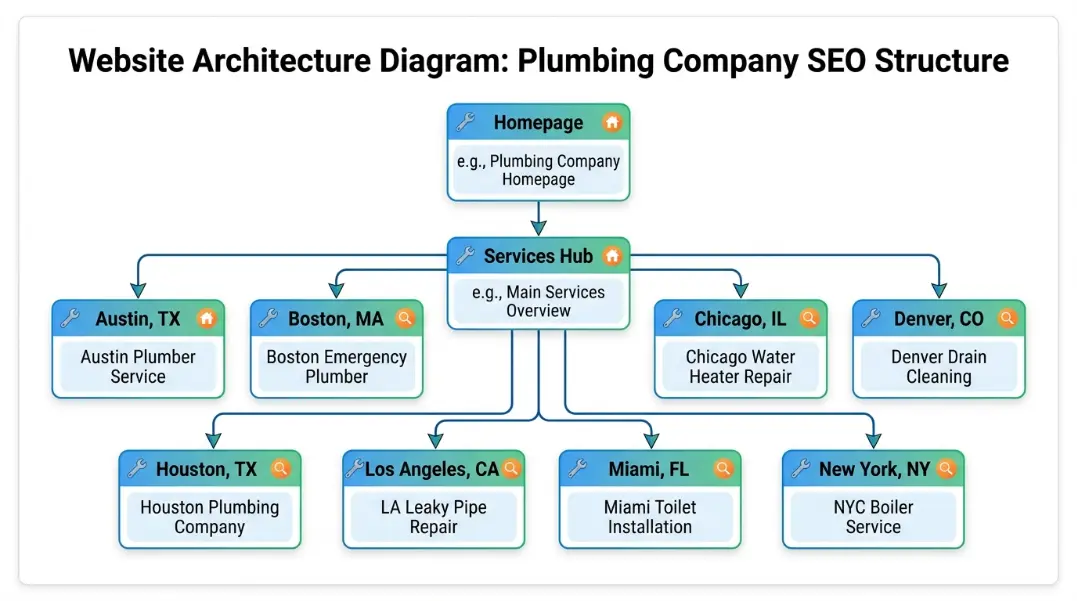
Service area pages solve this. A dedicated page for each major city or community within your service area gives Google location-specific content to match against searches like "plumber in [city]" and "[city] drain cleaning service." These pages rank in organic search results for city-specific searches and support Map Pack visibility for searchers further from your primary address.
What a service area page needs to work:
- City name in the page title, H1, and URL
- Genuine content about serving that specific area (not the same template text on every page)
- Local landmark or neighborhood references that signal authentic service coverage
- A specific service list relevant to that area's typical housing stock and issues
- A local phone number or tracking number if possible
- Internal links to and from your primary service pages
A plumbing company serving 12 cities that builds well-structured service area pages for each one has 12 additional pages generating organic traffic and supporting local Map Pack presence across the full service area. This compounds over time as each page accumulates its own authority. For the full approach to organic plumbing SEO that works alongside local optimization, the SEO for plumbers page covers website structure, keyword targeting, and content strategy.
Local SEO vs. Google Ads for Plumbers: Which Comes First?
This is the most common strategic question plumbing companies face, and the honest answer is that both serve different needs and work best together.
| Factor | Local SEO | Google Ads for Plumbers |
|---|---|---|
| Time to first lead | 3 to 5 months | Same week |
| Cost per lead at maturity | Low, decreases over time | $35 to $80 per call |
| What happens when you stop | Rankings persist | Calls stop immediately |
| Emergency keyword coverage | Strong once established | Immediate |
| Budget required to start | Lower | $1,500 to $3,000/month minimum |
The most cost-effective strategy for a plumbing company is to run Google Ads for plumbers in the first six to 12 months to generate calls while local SEO builds. As Map Pack rankings strengthen and organic calls increase, paid ad spend can be reduced. The long-term goal is a channel mix where organic and local SEO generate the majority of calls with paid supplementing during peak demand periods and covering any gaps in organic visibility.
How Long Does Local SEO Take for Plumbing Companies?
Map Pack movement from GBP optimization and citation cleanup typically appears in eight to 14 weeks, assuming there were no existing GBP problems like duplicate listings or a suspended profile. Citation cleanup alone, correcting inconsistent NAP data across directories, often produces noticeable ranking movement within this timeframe.
Organic website rankings for competitive plumbing keywords take longer. Terms like "plumber [city]" and "drain cleaning [city]" in large metro areas typically require six to 12 months of consistent on-page optimization, content building, and link acquisition to reach page one.
Realistic milestones for a plumbing company starting from scratch:
- Weeks 1 through 4: GBP fully optimized, citation audit complete, review request system live
- Months 2 through 3: First new reviews compounding, citation corrections indexed, initial Map Pack movement
- Months 3 through 5: Consistent review velocity, GBP posts active, Map Pack position stabilizing in top five
- Months 6 through 12: Competitive Map Pack position (top three in most markets), service area pages ranking organically, organic calls beginning to reduce paid ad dependency
The full plumbers marketing agency page covers how this timeline fits within a broader marketing strategy, including how paid and organic channels work together during the build period.
The Plumber Who Ranks in Position One Does Not Compete on Price
A plumbing company in the top Map Pack position, with a 4.8-star rating and 200 reviews, and a phone that is answered quickly does not negotiate price with emergency customers. Those customers are not shopping. They are calling the first result that looks trustworthy and booking the job.
That position is built systematically: a complete GBP, clean citation data, a review system generating new reviews every month, and service area pages covering your full radius.
If your plumbing company is currently invisible in the Map Pack or stuck below position three, talk to the Nextvure plumbing team about a free local SEO audit. We will show you exactly what the top-ranked competitor in your market has that you do not, and what it would take to close that gap.