Online Review Management Services: What They Do and Which Platforms Matter

The Difference Between Having Reviews and Managing Them
A home services company with 180 Google reviews at 4.6 stars looks competitive. Look closer and the picture changes: nine negative reviews from the last 90 days with no response, a Yelp profile carrying a wrong phone number, and an Angi listing sitting at 3.1 stars from two complaints the owner never addressed.
Those 180 Google reviews are not doing the work they should because the review management system is broken everywhere else. The volume is there. The system is not.
Online review management services fix this. They cover the specific work of getting reviews from customers, monitoring new reviews as they appear across platforms, and responding consistently. Most service businesses need strong review management much earlier than they need the broader scope of online reputation management, which covers search result content, press, and brand monitoring across the full web.
This guide explains what review management services actually include, which platforms matter most by industry, what working with a review management company looks like month to month, and when the investment makes sense versus managing it in-house.
How Review Management Differs from Online Reputation Management
The two terms get used interchangeably. They should not be, because they describe different scopes of work at different price points.
Online reputation management covers everything that affects how your business appears online: review profiles, search result content, news coverage, social media mentions, directory accuracy, and brand monitoring across the full web. Full ORM services make the most sense for businesses dealing with negative press, a reputation crisis, or content they want removed or buried in search results.
Review management is the subset of that work focused entirely on review platforms: generating reviews from real customers, monitoring them as they come in across every platform where your business has a presence, and responding to them quickly and correctly. For most local service businesses, including plumbing companies, dental practices, landscaping contractors, and restaurants, review management is the more pressing investment.
A business with 40 reviews at 4.4 stars does not need content suppression services. It needs a system that generates 15 to 25 new reviews per month, monitors every relevant platform, and responds to every review within 24 hours. That is review management, and it is where most service businesses should start.
What Are the Three Components of Review Management Services?
Every legitimate online review management service covers three distinct functions. Understanding each one helps you evaluate whether a vendor actually delivers all three or only the part that is easiest to automate and sell.
Review Generation
Review generation is the process of systematically asking every customer to leave a review after a service interaction. Most businesses that rely on voluntary review activity, customers who choose to leave reviews without being asked, accumulate reviews slowly and unevenly. Customers who had a negative experience are statistically more likely to leave a review unprompted than satisfied customers.
A generation system corrects this by asking every completed job, immediately after service delivery, with a direct link to the review form. According to BrightLocal's Local Consumer Review Survey, review requests sent within one to two hours of service completion convert at two to three times the rate of requests sent a week later. The interaction is still recent. The customer has not moved on.
The link structure also matters. Sending a customer to a landing page with three platform choices reduces conversion compared to sending them directly to the Google review form. Every additional step loses a percentage of requests.
Review Monitoring
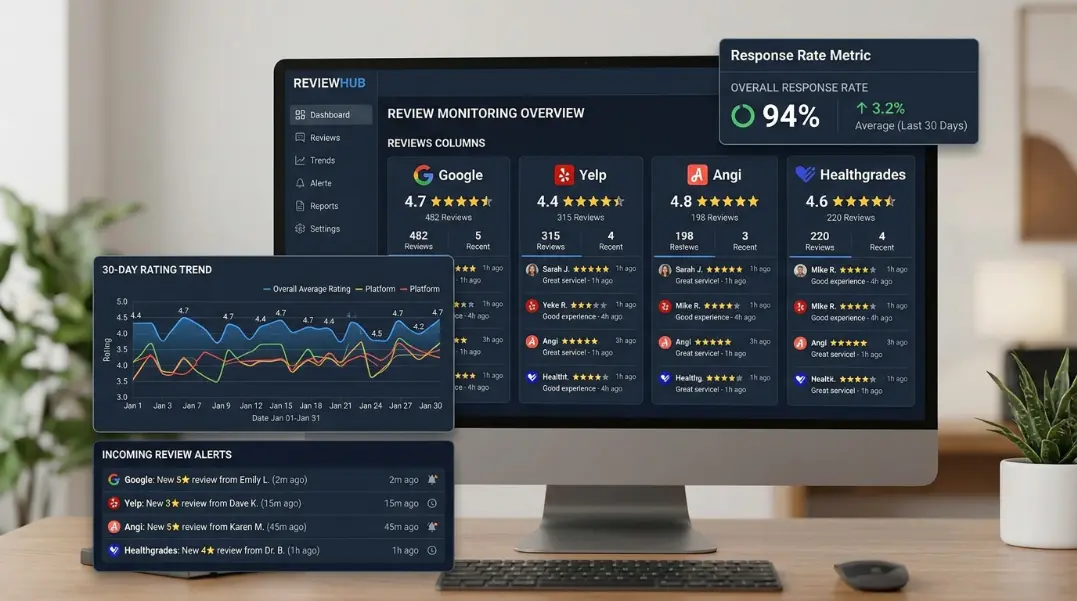
Review monitoring is continuous tracking of new reviews across every platform where your business appears. Without monitoring, a two-star review posted on a platform checked infrequently can sit for weeks without a response.
A negative review without any response signals to future customers that the business does not engage with feedback. A negative review with a professional, constructive response signals that the business takes concerns seriously. Future customers reading the review read the response too.
Monitoring covers more than just alert notifications. It tracks review velocity (new reviews per month), rating trends over time, platform-by-platform distribution, and how your review standing compares to top local competitors. That data informs where to focus collection effort and where response speed needs improvement.
Review Response Management
Responding to reviews is the component businesses most often skip or handle inconsistently. It matters more than most realize for two separate reasons.
First, public responses are read by future customers as they evaluate your business. A business that responds thoughtfully to both positive and negative reviews reads as more trustworthy than one that ignores them. Second, Google's local ranking algorithm treats review activity, including responses, as a prominence signal. Businesses that consistently respond to reviews show active engagement with their profile, which correlates with improved local visibility.
Response protocols differ by review type. Positive responses should be personalized to mention the specific service or project, not copy-pasted acknowledgements. Negative responses must acknowledge the concern, offer to resolve it offline, and avoid arguing specifics publicly. A visible argument in a response thread does more cumulative damage than the original negative review.
Which Review Platforms Matter Most by Industry?
Concentrating all review management effort on Google while neglecting industry-specific platforms is one of the most common gaps in how service businesses approach reviews.
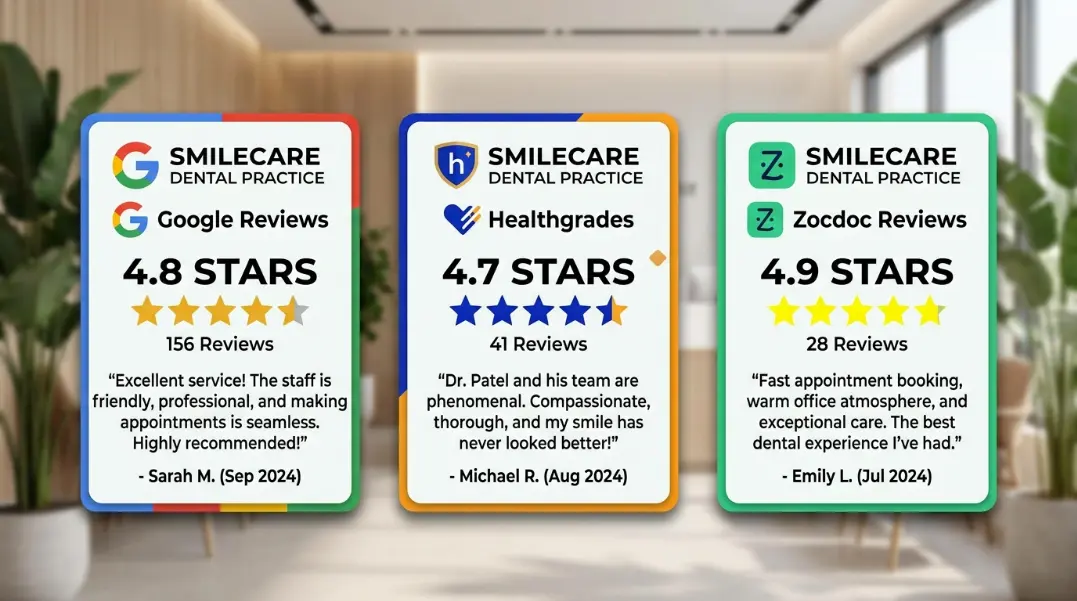
Google is always the highest priority. Google reviews feed directly into Map Pack rankings and appear prominently in branded searches. But the secondary platforms vary significantly by industry, and customers in certain categories, particularly dental, medical spa, and legal, actively use industry-specific platforms to research providers before ever visiting a website.
| Industry | Primary | Secondary | Industry-Specific Platforms |
|---|---|---|---|
| HVAC and Plumbing | Yelp | Angi, HomeAdvisor, Thumbtack | |
| Dental | Healthgrades | Zocdoc, 1-800-Dentist, Vitals | |
| Medical Spa | Yelp | RealSelf, Zwivel, Healthgrades | |
| Legal | Yelp | Avvo, Justia, FindLaw | |
| Landscaping | Yelp | Houzz, Angi, Thumbtack | |
| Restaurants | Yelp | TripAdvisor, OpenTable | |
| Auto Repair | Yelp | CarFax, RepairPal | |
| Home Services | Yelp | Angi, HomeAdvisor, BBB |
A dental practice with 200 Google reviews and eight Healthgrades reviews is missing a major trust signal for patients who use Healthgrades as their primary research tool. A medical spa with no RealSelf presence loses visibility to a large segment of aesthetic patients who research treatments on RealSelf before visiting any provider website.
The reputation management service page covers multi-platform strategy in more detail. For industry-specific platform breakdowns, the most relevant pages are reputation management for HVAC companies, reputation management for dental practices, and reputation management for plumbers.
What Do Online Review Management Companies Actually Do?
Most vendors are vague on this. Here is what a legitimate review management engagement should deliver month to month.
Setup phase (weeks one through four):
An audit of your current review profile across all relevant platforms. Configuration of automated SMS and email review request sequences triggered by job or appointment completion. Direct review link creation for each platform that bypasses intermediary landing pages. Monitoring dashboard setup across all platforms with response-time alerts. A defined response protocol covering positive reviews, neutral reviews, and negative reviews, matched to your brand voice.
Ongoing monthly work:
Review requests sent automatically after each completed job or appointment, with conversion rate tracked and adjusted. Daily monitoring dashboard checks, with new review alerts triaged within four hours during business days. Responses written for every new review. A monthly report covering total review count by platform, new reviews this month, rating trend, response rate, competitor standing in your market, and specific recommendations for the next 30 days.
What a service should never include:
Fake reviews or incentivized reviews violate Google's terms of service and risk the removal of your entire review profile if detected. Bulk review acquisition from non-customers produces reviews that read inauthentic and can be flagged. Suppression of negative reviews through any method other than legitimate dispute of policy-violating content is not something a credible service offers.
If a vendor promises a specific review count within a specific timeframe without knowing your monthly job volume, that is a concern. Review volume is directly tied to the number of real customer interactions you have each month, not to what a vendor can generate independently.
How Long Does It Take to Build a Review Profile?
The timeline depends on job or appointment volume, but here is a realistic range for service businesses.
A plumbing company completing 60 jobs per month with a 35 percent review conversion rate generates 21 new Google reviews per month. After six months, that is 126 new reviews compounding on whatever baseline already exists. A dental practice with 40 patient visits per week and 20 percent conversion generates roughly 32 reviews per month.
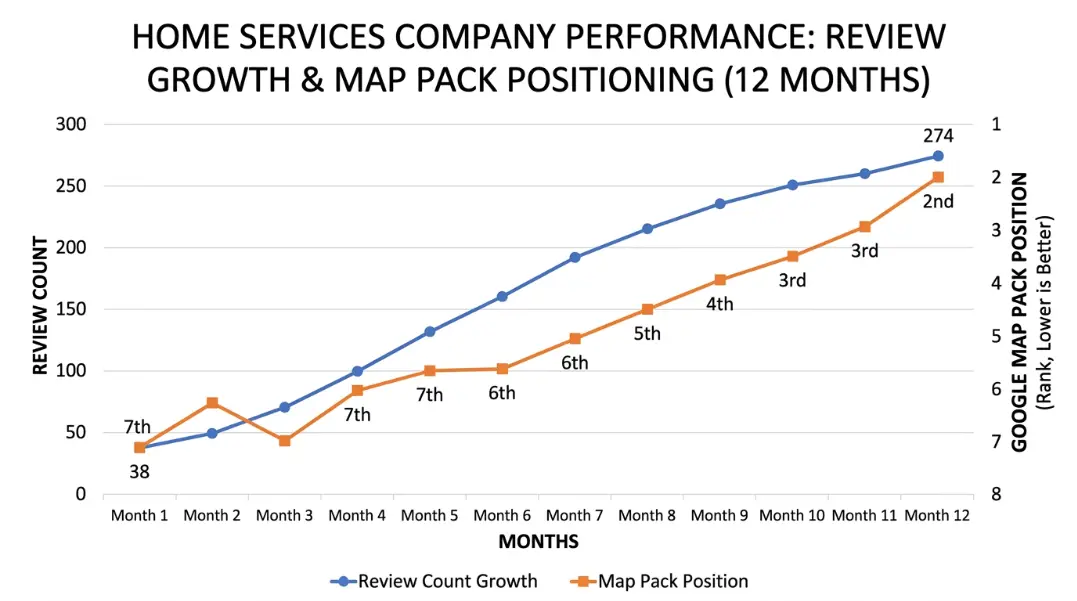
Map Pack ranking improvement from a systematic review program typically appears between three and five months after launch. Google's prominence algorithm rewards consistent review generation over time, not a single burst of volume. A business that generates 200 reviews in one month and stops gains less long-term ranking benefit than one that generates 20 reviews every month for a year. Recency signals matter alongside total count.
The competitive bar also varies by market. A plumbing company in a smaller city may need 80 reviews to hold a top-three Map Pack position. In a major metro, the bar is often 250 to 400. Understanding the competitive threshold in your specific market is the first step in setting realistic targets.
When Does Hiring a Review Management Service Make Sense?
A self-managed tool subscription (Podium, Birdeye, or GatherUp) is sufficient for businesses with a single location, an owner actively involved in day-to-day operations, and enough in-house capacity to handle monitoring and responses consistently. Monthly costs for self-managed tools run $200 to $500.
A managed review management service makes more sense in four situations.
High job volume. A business completing 80 or more jobs per month cannot track review requests, monitor platforms, and write responses without significant staff time. Automation and outsourced response management pays for itself at this scale.
Multiple locations. Each location needs its own Google Business Profile, its own review request workflow, and its own monitoring setup. Managing three or more locations without a dedicated service creates gaps in coverage.
Negative reviews accumulating without response. If recent reviews include several with no response and no resolution offer, the profile is actively working against conversion. A managed service fixes this systematically and quickly.
Staff turnover disrupting the process. Review management that depends on one person handling it correctly every day breaks the moment that person leaves. Outsourcing removes the single-point-of-failure problem.
A Consistent System Outperforms a High Starting Count
A business with 80 reviews generating 25 new ones per month will outrank a competitor with 300 reviews that stopped generating new ones six months ago. Review recency matters as much as volume in Google's local ranking signals.
Building that consistency requires a system. If your team depends on customers deciding to leave reviews on their own, you are leaving review volume and Map Pack position on the table every single month.
Talk to Nextvure about building a review management system for your business, including the platform setup, timing protocols, and response workflows that generate the highest review conversion rates in your industry.