Plumber Marketing: How to Get More Leads and Book More Jobs in 2026
When the Pipe Bursts, the Job Goes to Whoever Answers First
A homeowner with water pooling under their kitchen sink is not comparison-shopping.
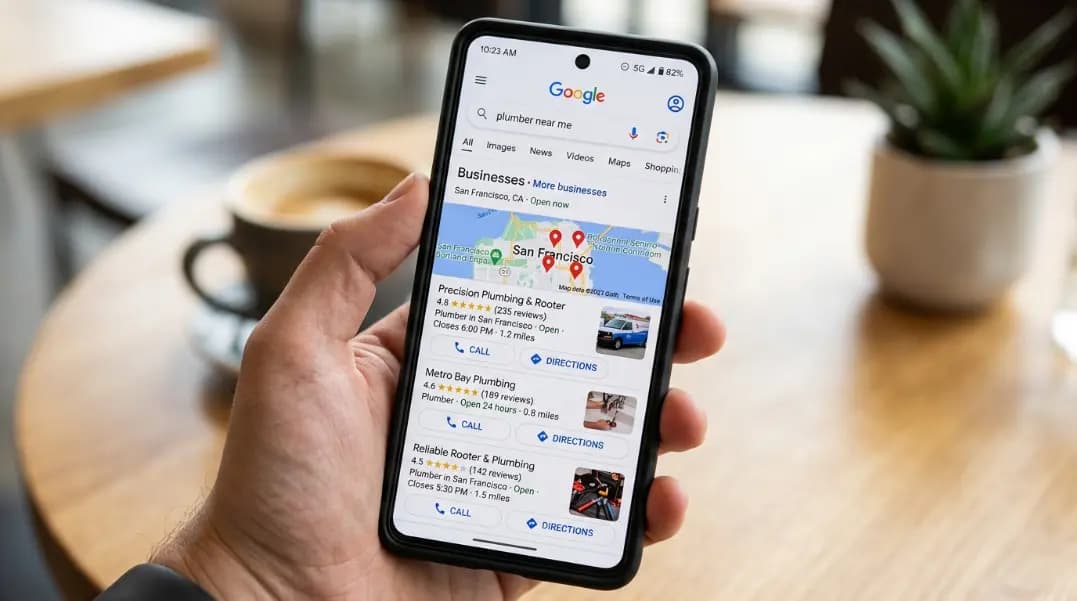
They search "plumber near me," see three results in the Map Pack, and call the first one that looks trustworthy. If the call goes to voicemail, they call the second. If that one puts them on hold, they call the third. The job is decided in under five minutes, and whoever picks up (or texts back immediately after missing the call) gets booked.
This is what makes plumbing marketing different from almost every other service industry. The majority of plumbing calls are same-day decisions driven by a problem the customer cannot defer. A dripping faucet might wait a week, but a burst pipe, a backed-up main line, or a water heater that stopped working at 6 AM on a Monday is not a wait-and-see situation.
That emergency-driven buying behavior has specific marketing implications. The channels that matter most are the ones that put you in front of someone the moment they search. Your review count matters because it is the fastest trust signal someone can assess in 10 seconds. Your response time matters because plumbing leads go cold faster than almost any other home service category.
This guide covers every plumbing marketing channel that produces results in 2026, what each one costs and delivers, how to structure your marketing to capture both emergency and planned work, and what the most common mistakes plumbing companies make that cost them jobs they should have won.
Why Plumbing Marketing Behaves Differently Than Most Service Businesses
Plumbing sits at an extreme on the emergency-versus-planned spectrum.
Most home service businesses carry a mix of planned work (installations, remodels, scheduled maintenance) and emergency calls. Roofing skews toward storm-season and planned replacements. HVAC has clear emergency peaks in summer and winter but also a steady planned tune-up and replacement market. Plumbing skews harder toward emergency than almost any other trade.
Industry estimates put between 70 and 85 percent of residential plumbing calls in the same-day or next-day urgent category. Emergency plumbing searches (burst pipes, clogged drains, no hot water, sewer backups) do not follow seasonal patterns the way HVAC does. They spike in winter during pipe freeze events and after heavy rain, but they run year-round at a meaningful volume.
This emergency weight creates two specific marketing requirements that many plumbing companies overlook.
First, your availability signals have to be visible before someone even calls. If your Google Business Profile shows "Closed" when a pipe breaks at 8 PM, you lose the job to whoever shows "Open 24 Hours." If your listing does not have a prominently displayed phone number and a recent set of positive reviews, searchers skip past you even if you rank in position one.
Second, your response system needs to operate within minutes. A study by HubSpot found that responding to a service inquiry within five minutes increases conversion by 300 percent compared to responding in 30 minutes. For emergency plumbing, that gap may be wider, because the customer's problem is active and getting worse while they wait.
The planned side of plumbing (repiping, water heater replacement, bathroom remodels, drain camera inspections) requires a different approach. These customers research, compare quotes, read reviews carefully, and take days or weeks to decide. Capturing this market requires content that reaches them before they hit emergency mode and a reputation that makes them want to choose you when they finally call.
Which Plumber Marketing Channels Actually Produce Leads?
Not every channel performs the same for plumbing companies. Here is what each one delivers, what it costs to run well, and which customer type it reaches.
| Channel | Best Customer Type | Time to Results | Cost per Lead Range |
|---|---|---|---|
| Google Local Services Ads | Emergency, verified jobs | Same week | $20 to $50 per contact |
| Google Ads (Search) | Emergency and replacement | Same day | $35 to $80 per call |
| Local SEO / Map Pack | Both types | 3 to 5 months | Decreases over time |
| Organic SEO Content | Planned and research phase | 6 to 12 months | Lowest at scale |
| Missed Call Text-Back | Emergency callers missed | Immediate | Near-zero, setup cost only |
| Email to Existing Customers | Seasonal and maintenance | Same day | Near-zero cost |
| Review Management | Supports all channels | Ongoing | Indirect conversion lift |
The key takeaway: emergency plumbing leads require channels that fire the moment someone searches, not channels that build over time. A plumbing company investing only in content marketing and organic SEO will have low-cost leads eventually, but will lose the majority of emergency jobs to competitors visible in paid and local search positions right now.
The most cost-efficient plumbing marketing uses paid channels (LSA and Google Ads) to capture immediate emergency volume while local SEO builds in parallel. Over 12 to 18 months, organic rankings reduce dependence on paid spend. The plumber marketing agency page covers how this channel mix is structured for different market sizes.
How Does Local SEO Work for Plumbing Companies?
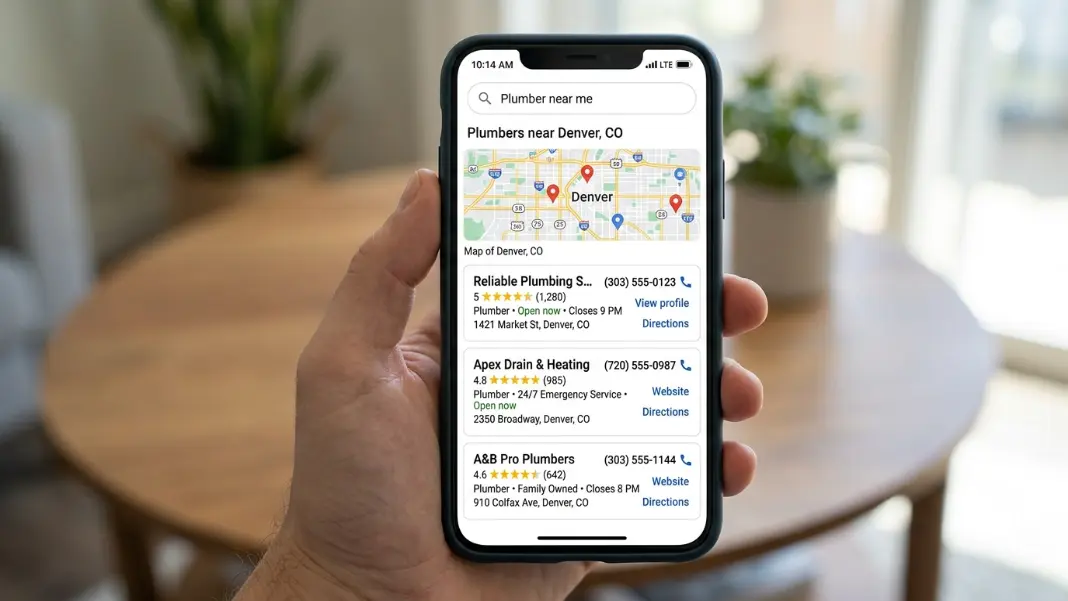
For most plumbing companies, local SEO is not about ranking page one of Google for broad terms. It is about ranking in the Map Pack, the three local business results that appear above the organic listings for searches like "plumber near me" or "drain cleaning [city name]."
Map Pack results generate the majority of calls for local plumbing searches. Someone searching for an emergency plumber does not scroll down to read a blog article. They see three results with star ratings and phone numbers and call the top one that has enough reviews to look trustworthy.
Your Map Pack ranking is determined by three factors: relevance (whether your Google Business Profile categories match the search query), distance (how close you are to the searcher), and prominence (how trusted your business is based on reviews, citation consistency, and website authority).
Relevance is set by your GBP categories and services. Distance is geographic. Prominence is what you actually control, and it is where the ranking gap between competitors in the same service area comes from.
A plumbing company with 240 reviews averaging 4.8 stars, accurate and consistent NAP data across 40 or more directories, regular GBP posts, and a well-built website will outrank a competitor with 60 reviews and an incomplete profile in most markets. The work of local SEO for plumbers covers completing every field in your GBP, selecting the right service categories (Emergency Plumber, Drain Cleaning Service, Water Heater Installation), building plumbing-specific directory citations, and running a systematic review request after every job close.
One plumbing-specific factor: your hours listing matters more in this category than almost any other trade. If you offer 24-hour emergency service, that needs to be reflected correctly in your GBP hours and service listings. An incorrect "Closed" status during an emergency call peak will suppress your visibility at exactly the moment your phones should be ringing.
Reviews Are Not Just a Trust Signal for Plumbers
In most home service categories, reviews help. For plumbing specifically, reviews are often the deciding factor because of the nature of the work itself.
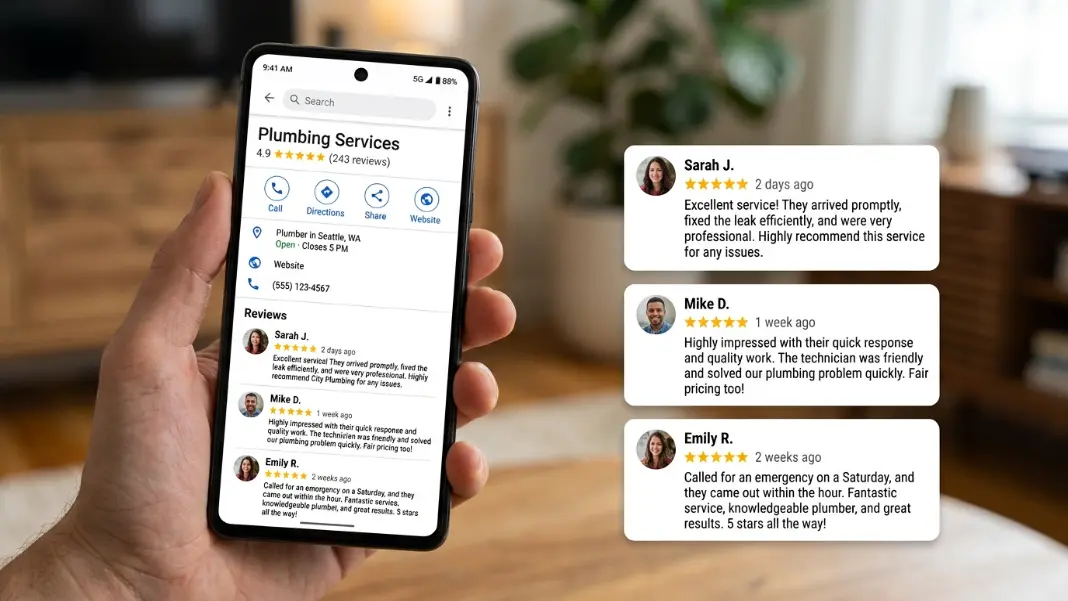
A plumber is coming into your home. They will have access to your foundation, pipes, walls, and often your water supply shutoffs. For homeowners, this is a higher-trust situation than a landscaper trimming the yard or a technician servicing an outside unit. Review count and rating tells the homeowner: other people trusted this company, and they were satisfied.
A plumbing company with 20 reviews at 4.5 stars loses to a competitor with 180 reviews at 4.8 stars in almost every case where the homeowner has two seconds to compare both options in the Map Pack. The difference is not just perception. More reviews at a higher average rating directly affects your Map Pack ranking through Google's prominence signals.
The most effective review generation system for plumbing companies is an automated SMS sent within one hour of marking the job complete in your CRM or scheduling tool. The message should include the customer's first name, a brief personal thank-you, and a direct link to the Google review page, not a landing page with multiple options. A direct link to the review form. Requests sent while the interaction is still fresh convert at two to three times the rate of requests sent days later.
Reputation management for plumbers handles this system and the ongoing response management that keeps your review profile growing and your average rating protected.
Google Ads and Local Services Ads for Plumbers
Google Ads produces the fastest plumbing leads of any channel. For emergency work, the cost per call is often justified by the job value, but poorly managed campaigns drain budget fast.
A well-run Google Ads plumbing campaign in most US markets produces calls at $35 to $80 per call. At an average service call of $200 to $400, and a water heater replacement at $1,000 to $2,500, the economics work when the campaign is built correctly. What separates profitable campaigns from wasteful ones is negative keyword management. Without a clean negative keyword list, you pay for clicks from people searching "how to unclog a drain yourself," "plumbing school near me," "PVC pipe dimensions," and dozens of other phrases that use plumbing keywords but have zero purchase intent.
A well-built plumbing campaign maintains 150 to 250 negative keywords and is organized by job type (emergency, drain, water heater, general plumbing) so budgets can be allocated by service value, not just by category.
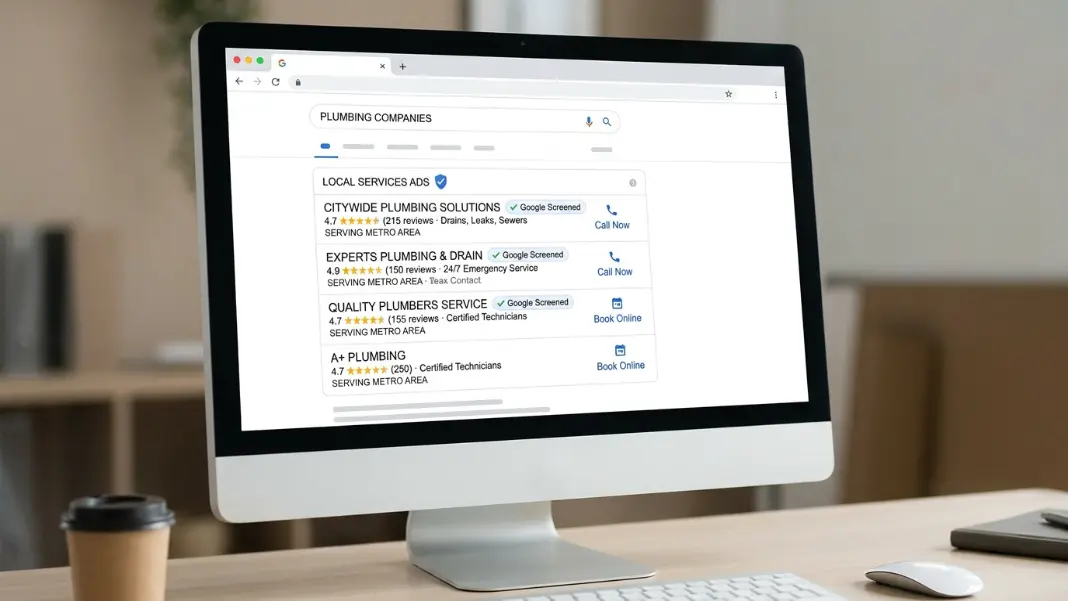
Google Local Services Ads are a separate product worth running alongside standard search campaigns. LSA shows a "Google Screened" badge next to your listing, which carries significant trust weight for a category where customers are letting a stranger into their home. Google verifies your contractor license and insurance before showing your LSA profile, and charges per contact rather than per click. LSA contacts tend to convert at a higher rate than standard PPC clicks for exactly this reason.
The Google Ads for plumbers page covers full campaign structures including emergency call routing, after-hours bid strategies, and job-type budget splits.
What Does a Realistic Plumber Marketing Budget Look Like?
Budget allocation for plumbing marketing depends on business size, market competition, and whether you are trying to hold existing market share or grow into new service areas.
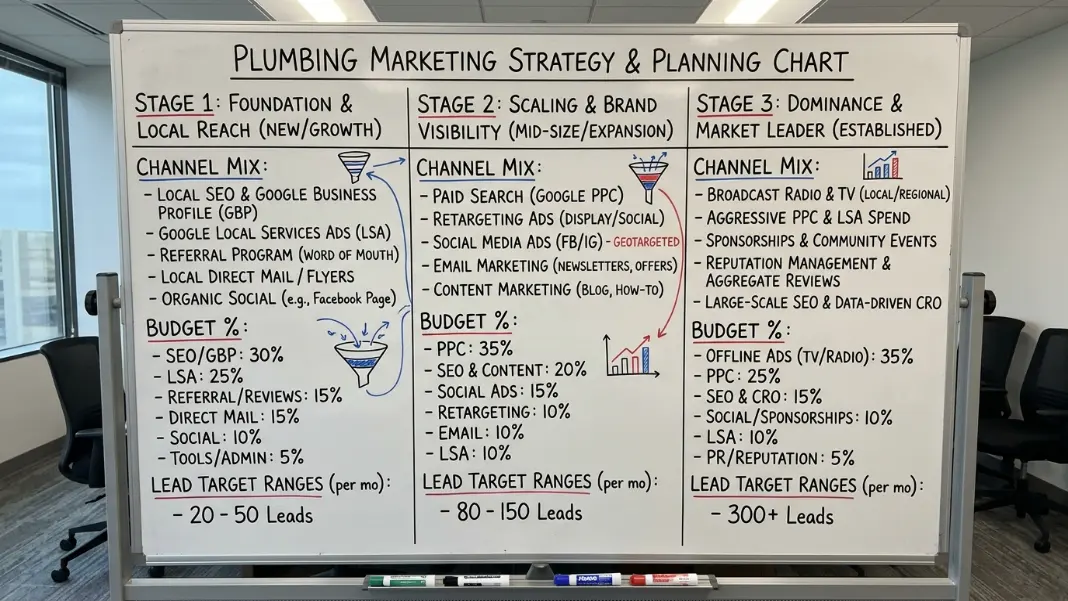
| Business Stage | Monthly Spend | Recommended Allocation | Expected Outcome |
|---|---|---|---|
| Starting Out | $1,500 to $2,500 | 60% Google Ads/LSA, 40% local SEO | 20 to 40 leads/month, early Map Pack traction |
| Growing | $2,500 to $5,000 | 50% paid, 30% SEO, 20% content | 40 to 80 leads/month, Map Pack position 1 to 3 |
| Scaling | $5,000 to $10,000 | 40% paid, 30% SEO, 20% content, 10% reputation | 80 to 150+ leads/month, multiple area rankings |
These numbers assume the spend is managed by someone who understands plumbing specifically. A general agency running broad keyword targeting without proper negative keyword management, campaign splits by service type, or emergency call routing will produce much higher cost per lead than a team that has built these campaigns before.
The most common budget mistake plumbing companies make is over-allocating to paid while under-investing in the systems that protect conversion: review generation, response speed, and website clarity. Getting the call is only half the job. Converting the call into a booked appointment depends on how fast you answer, how your intake handles emergency urgency, and whether the customer can book online if they reach you after hours.
Common Plumber Marketing Mistakes That Cost Real Jobs
No after-hours system. Plumbing emergencies do not follow business hours. A missed call at 9 PM without an immediate text-back or after-hours routing means the customer calls the next result before your team opens Monday morning. Even a simple automated text ("We got your message and will call back within 15 minutes") keeps the lead warm enough to recover.
An incomplete or inaccurate Google Business Profile. Wrong hours, missing service categories, no photos, or an address inconsistent with your directory listings can suppress your Map Pack visibility. GBP needs regular posts, photos from actual jobs, and accurate hours including holiday and emergency availability. Setting it up once and leaving it is not a strategy.
No systematic review requests. Plumbing companies with 200 reviews did not get them by chance. They ask every customer, immediately after every job, with a direct link to the Google review page. Waiting for customers to volunteer reviews produces a trickle. A consistent same-day ask produces a steady flow that compounds month over month.
Spending on ads without tracking calls by source. Without call tracking numbers assigned to each marketing channel, you cannot tell whether leads are coming from Google Ads, your LSA listing, organic search, or your GBP profile. Cutting a channel that appears expensive may eliminate your best lead source. Budget decisions made without attribution data are arbitrary.
Treating drain cleaning and repiping the same way in ads. Drain cleaning is typically a $150 to $300 ticket. Repiping a house is $5,000 to $15,000. The keyword intent, the customer psychology, the messaging, and the economics of advertising are different for each. Campaigns that group these under one "plumbing" bucket produce higher average CPL because budget spreads across very different job values.
Ignoring the planned market while chasing emergency work. Content that reaches homeowners before a problem turns urgent ("signs your water heater needs replacing," "how long do sewer lines last," "what causes recurring drain clogs") captures customers in the research phase who will call a trusted name when the situation gets serious. Content marketing for plumbers builds this pipeline over time, reducing dependence on paid emergency traffic.
Building a Plumber Marketing System That Fills Your Schedule
A plumbing company that shows up first in the Map Pack, answers quickly, and carries 200 reviews at 4.8 stars does not compete on price. Emergency customers do not shop three quotes when water is pooling on their floor. They call the first result that looks trustworthy, and the job is done before they have time to look elsewhere.
That position is built systematically. Local SEO and GBP management build the organic foundation. Paid ads fill the schedule while organic work matures. A review system generates new reviews after every job, compounding the trust signals month over month.
If you want to see what the plumbing marketing opportunity looks like in your specific service area, which channels are underperforming, where competitors are outranking you, and what a 90-day action plan would look like, the Nextvure plumber marketing team offers a free audit with no commitment. Request yours here.