Data Analytics Agency: What They Do and When You Need One

You Have the Data. You Still Can't Answer the Question.
Most marketing teams in the USA are not short on data. They have Google Analytics showing traffic. They have ad platform dashboards showing spend and clicks. They have a CRM showing leads and pipeline. They have email platform reports showing open rates. Some have a BI tool sitting on top of all of it.
What most of these teams cannot do is answer the question that actually matters: which of these channels is producing revenue, and which is burning budget without producing anything proportional to what it costs?
That gap between data collected and decisions made is exactly where a data analytics agency operates. Their job is not to generate more reports. It is to connect your data sources, remove the noise, and produce answers that tell you where to spend the next dollar and where to stop.
This guide covers what a data analytics agency actually does, the specific deliverables you should expect, the situations that signal you need one, and how to evaluate your options.
What Is a Data Analytics Agency?
A data analytics agency is a firm that collects, connects, and interprets business and marketing data to improve decision-making. They differ from a standard marketing agency in one specific way: they do not run your campaigns. They analyze the results of all your campaigns across every channel and tell you what is working, what is not, and what the data says you should do next.
They also differ from a business intelligence (BI) consulting firm. BI consultants typically build internal data infrastructure: data warehouses, pipelines, and reporting systems. A data analytics agency does some of this, but their primary output is insight and recommendation, not infrastructure. The goal is decisions, not dashboards.
Nextvure's data analytics services sit at this intersection: connecting paid, organic, and CRM data into a single view of revenue attribution, then using that view to direct budget and strategy.
What Does a Data Analytics Agency Actually Deliver?
This is where most explanations fall short. "Insights" and "data-driven decisions" are not deliverables. Here is what a real engagement should produce.
Marketing Attribution Modeling
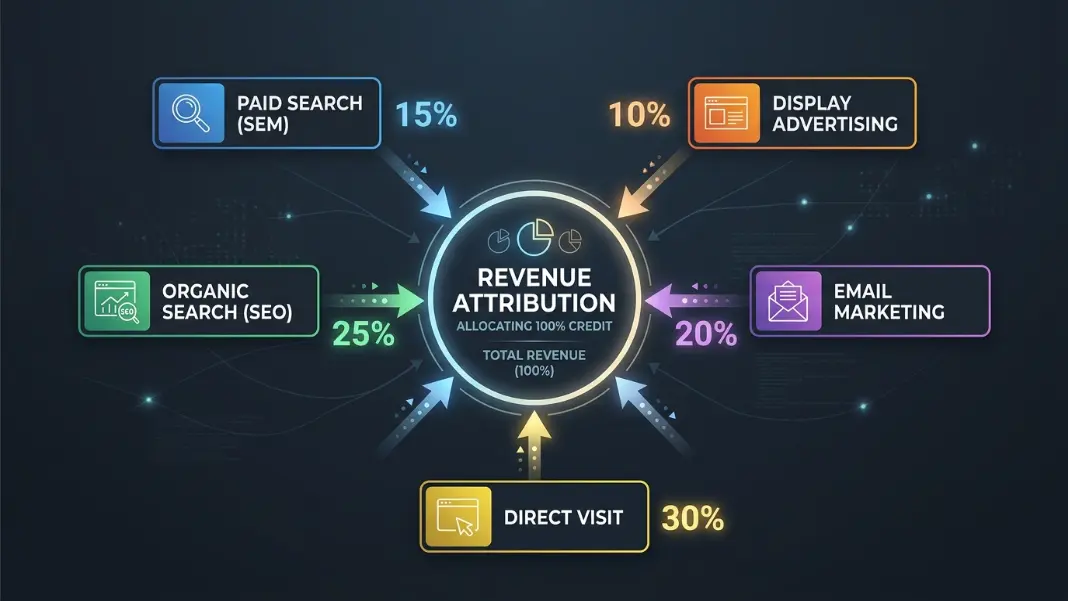
Attribution answers the question: which channels, campaigns, and keywords deserve credit for a conversion? Last-click attribution, the default in most platforms, gives all credit to the last touchpoint before conversion. This consistently overvalues direct traffic and brand search while undervaluing the content, display, and paid campaigns that introduced the customer earlier in the cycle.
A data analytics agency builds a multi-touch attribution model that distributes credit across the full customer journey. This changes budget allocation decisions significantly. When clients switch from last-click to a properly calibrated model, they typically find that one or two mid-funnel channels were generating far more pipeline than the dashboards showed, while one or two bottom-funnel channels were less indispensable than they appeared.
Unified Reporting Dashboards
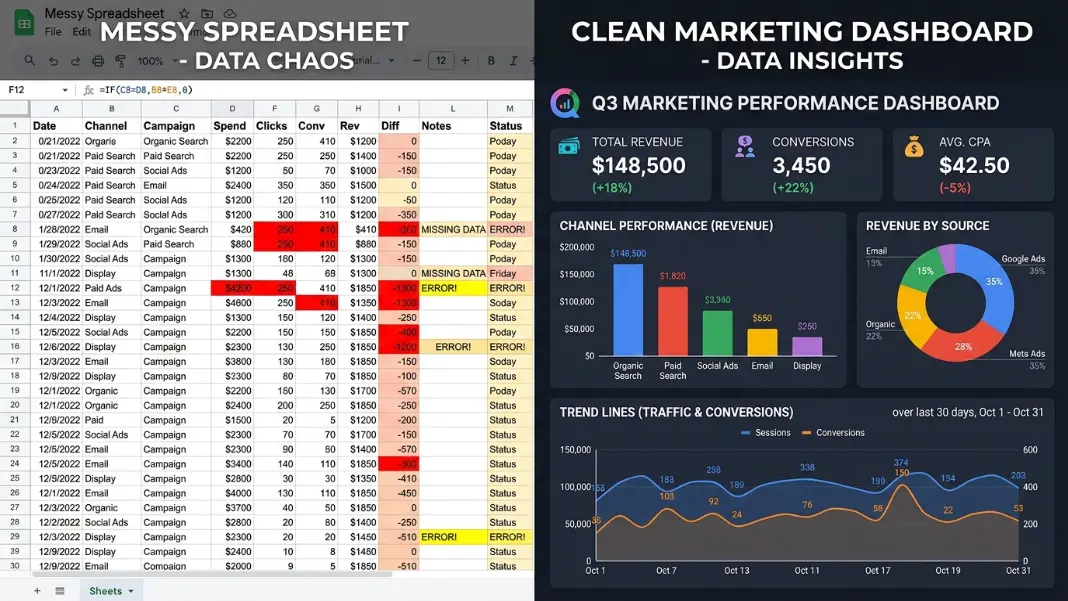
Most businesses have data sitting in four to eight separate tools that do not communicate with each other. An agency connects these sources, Google Analytics 4, ad platforms, CRM, email, into a single dashboard that shows the full picture. This removes the manual work of pulling numbers from multiple systems and eliminates the discrepancies that happen when different tools count the same conversion differently.
The dashboard itself is not the deliverable. The question the dashboard answers is the deliverable.
Revenue and Pipeline Analysis
Beyond channel performance, a data analytics agency analyzes revenue patterns: which customer segments have the highest lifetime value, which acquisition sources produce customers who stay versus those who churn, which product or service lines have the strongest margin, and where the pipeline is leaking between stages.
This analysis directly informs which marketing campaigns are worth scaling. A channel that produces high volume but low-LTV customers is worth less than it looks. A channel that produces fewer leads with longer retention is worth more.
Forecasting and Scenario Planning
With enough historical data, a data analytics agency builds models that project future performance under different budget scenarios. Rather than guessing what happens if you increase paid search spend by 40 percent, a model shows the expected outcome based on historical conversion rates, seasonal patterns, and market conditions. These models are especially useful for B2B companies with longer sales cycles where the connection between spend and revenue is not immediately visible.
Audience Segmentation
Analytics work identifies which customer segments respond to which messages and which channels. This feeds directly into paid advertising targeting and conversion rate optimization testing, reducing cost per acquisition by concentrating spend on audiences with demonstrated purchase intent.
What Are the Signs Your Business Needs a Data Analytics Agency?
The need for a data analytics agency shows up in specific, recognizable situations. Most of them come down to the same underlying problem: you have data, but it is not making decisions easier.
You cannot answer "what is our cost per acquisition by channel" without opening three platforms. If producing that number takes 30 minutes of manual work, your attribution setup is broken.
Your ad spend decisions are based on platform-reported conversions only. Google Ads reports that a campaign drove 80 conversions. Your CRM shows 20 closed deals that came in through search. That discrepancy is real, and the decision you make based on 80 is different from the one you make based on 20.
You are scaling a channel based on volume, not revenue. A campaign that produces 200 leads per month at $15 each looks better than one producing 40 leads at $60 each. But if the second campaign produces customers with three times the lifetime value, the math reverses entirely.
Your monthly reporting takes a full day to pull together. Manual reporting at this scale signals that data infrastructure has not kept pace with the business.
You are making budget decisions on gut instinct. Not because you prefer to, but because no single source of truth exists to tell you what the data actually says.
Any one of these situations warrants attention. All of them together means measurement gaps are actively limiting growth.
In-House Analyst vs. Data Analytics Agency: Which Makes More Sense?
This is the real decision most growing businesses face, and the honest answer depends on several factors.
| Factor | In-House Analyst | Data Analytics Agency |
|---|---|---|
| Setup Time | 3 to 6 months to hire and onboard | 2 to 4 weeks to begin analysis |
| Tool Coverage | Deep in known tools, gaps elsewhere | Cross-platform by design |
| Annual Cost | $80,000 to $130,000 salary plus tools | $36,000 to $144,000 depending on scope |
| Scalability | Fixed capacity, bottleneck at scale | Scales with project scope |
| Perspective | Internal bias can form over time | External view catches patterns internal teams miss |
| Benchmarking | Limited to company history | Cross-industry data and channel benchmarks |
For businesses under $5M in annual revenue with a straightforward marketing stack, a strong in-house analyst is often the right first step. For businesses with complex multi-channel operations, multiple data sources, or a need for revenue attribution across a longer sales cycle, an agency provides the cross-platform depth and tooling that a single analyst cannot replicate.
Many mid-market companies use both: an in-house analyst managing day-to-day reporting, plus an agency partnership for attribution modeling, forecasting, and quarterly strategic analysis.
What to Look for When Choosing a Data Analytics Agency
Not every agency that calls itself a data analytics firm delivers the same thing. Here is what to evaluate before signing.
They Talk About Attribution Before Anything Else
A strong data analytics agency spends significant time in the first conversation understanding how your current attribution model works and where it breaks down. If an agency jumps straight to dashboard design without asking about attribution, they are focused on reporting aesthetics rather than decision quality.
They Know Your Specific Tool Stack
Google Analytics 4, Salesforce, HubSpot, Google Ads, Meta Ads, and Shopify each have distinct data structures and quirks. An agency with direct experience in your specific tool combination will spend far less time in setup and far more time in analysis. Ask specifically which platforms they connect most frequently.
They Deliver Recommendations, Not Just Reports
Every analysis should produce a recommendation. Not "here is what the data shows" but "here is what the data shows, and here is what we recommend doing because of it." An agency that sends dashboards without recommendations is a reporting subscription, not a strategy partner.
They Set Honest Timelines for Attribution Work
Multi-touch attribution models take time to calibrate. A responsible agency tells you the model requires a minimum of 60 to 90 days of data before recommendations drawn from it are reliable. Be skeptical of any agency promising full attribution clarity within two weeks.
They Connect to Your CRM
Web analytics data without CRM data only tells half the story. An agency that cannot or will not connect to your CRM produces recommendations that optimize for leads rather than revenue. That distinction costs real money.
How Nextvure Approaches Data Analytics
Nextvure's approach to data analytics starts with attribution before anything else. The first step in every engagement is auditing how current reporting is configured, identifying where data sources conflict, and building a single source of truth that connects marketing channel spend to CRM revenue.
From there, we build the reporting infrastructure and attribution model, then deliver monthly analysis with specific recommendations tied to budget allocation, channel mix, and audience targeting. Every recommendation comes with the data that supports it and a clear explanation of what the data does and does not say.
For clients who invest in predictive marketing, data analytics provides the necessary foundation. Without accurate historical attribution data, predictive models produce results that are confidently wrong. Getting attribution right first is what separates a predictive model that improves decisions from one that compounds existing errors.
If your current reporting cannot tell you which channel produced your last ten closed deals, start with a data audit before adding more channels or scaling existing spend.

What Does a Data Analytics Agency Cost?
Pricing varies by scope, but here are the ranges most US businesses should plan for.
| Engagement Type | Typical Cost | What's Included |
|---|---|---|
| Reporting and Dashboard Setup | $1,500 to $3,500/month | GA4 configuration, unified dashboard, basic channel reporting |
| Attribution Modeling | $3,000 to $6,000/month | Multi-touch model, CRM connection, attribution report |
| Full Analytics Partnership | $5,000 to $12,000+/month | Attribution, forecasting, audience analysis, monthly strategy |
| One-Time Data Audit | $2,500 to $7,500 flat | Tracking audit, attribution gap report, recommendations |
Project-based engagements work well for businesses that need a defined fix: incorrect GA4 configuration, a broken attribution setup, or a one-time revenue analysis. Retainer engagements work better when continuous analysis is needed as campaigns run and data accumulates month over month.
The cost of inaccurate attribution typically exceeds the cost of fixing it. A business spending $50,000 per month on paid channels with broken attribution is likely misallocating 20 to 35 percent of that spend based on platform data that does not match CRM reality.

The Data You Have Is Already Enough
The most common reason businesses delay analytics work is the belief that they need more data before analysis makes sense. In practice, the opposite is true. Most businesses already collect far more data than they act on. The gap is not in collection. It is in connection and interpretation.
A data analytics agency connects what you already have, removes the measurement noise that makes channel performance look inconsistent across platforms, and produces the specific answers that budget decisions require.
If your team cannot answer "which channel drove our last ten closed deals" without opening three separate tools, that gap costs money every month it stays open. Talk to the Nextvure analytics team to see what accurate attribution would change about your current channel mix.