Online Reputation Management Services: What They Include and How to Choose the Right Agency

Why Your Online Reputation Is Costing You More Than You Think
Before a customer calls your business, most of them have already looked you up. They checked your Google reviews, scanned your star rating, and possibly searched your business name to see what fills page one. What they find there decides whether they call or move on to the next result.
This plays out in every service industry: HVAC, legal, dental, restaurants, home services, auto repair. The common thread is that trust matters before any transaction begins, and that trust is now built or broken online before anyone picks up the phone.
Online reputation management services exist to give businesses control over that first impression. But the term gets used loosely. Some agencies use it to mean review generation. Others mean content suppression. A few genuinely cover the full scope.
This guide explains exactly what reputation management services include, how the search engine side of ORM works, who actually needs it, and what separates a qualified agency from one that takes your money and delivers a monthly PDF of activities.
What Is Online Reputation Management?
Online reputation management is the ongoing process of monitoring, shaping, and improving how your business appears across search results, review platforms, social media, and directories.
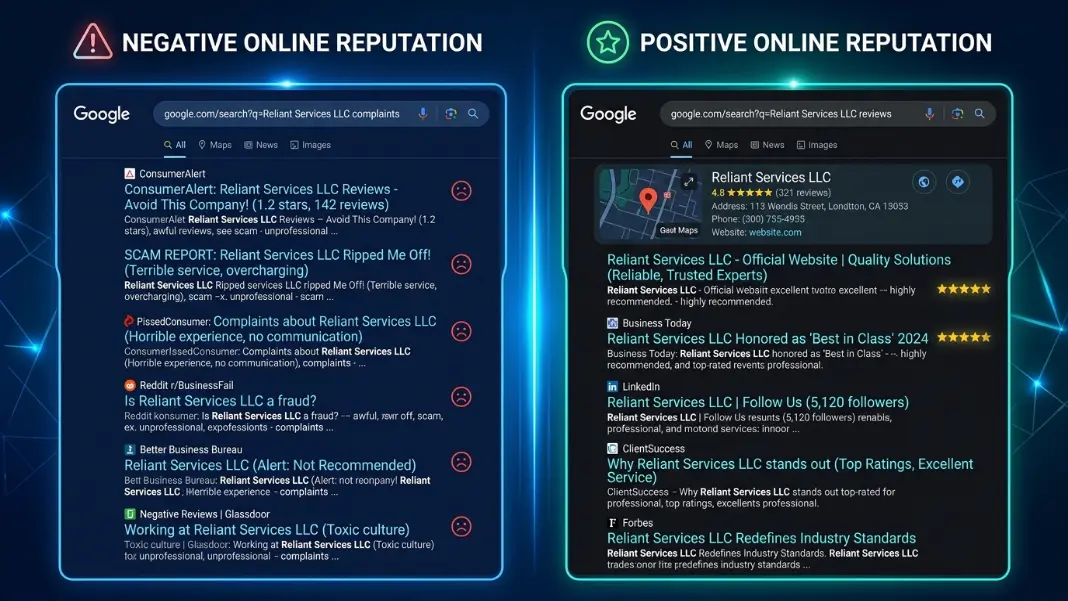
The goal is that when someone searches your business name, they find accurate, positive, and professionally managed information. That means solid reviews, clean search results, consistent business listings, and no unchallenged negative content sitting at the top of page one.
ORM is not the same as public relations, though they share some territory. PR focuses on media coverage and brand narrative. ORM focuses specifically on the digital footprint: what Google shows, what review platforms say, and what appears when a prospective customer types your name into a search bar.
It is also not the same as standard SEO, though a specific branch of ORM called search engine reputation management (SERM) uses many of the same techniques applied to branded searches rather than keyword searches.
What Do Online Reputation Management Services Actually Include?
This is where most business owners get surprised. A reputation management service is rarely one single action. It is a set of ongoing activities that each target a different layer of your digital presence.
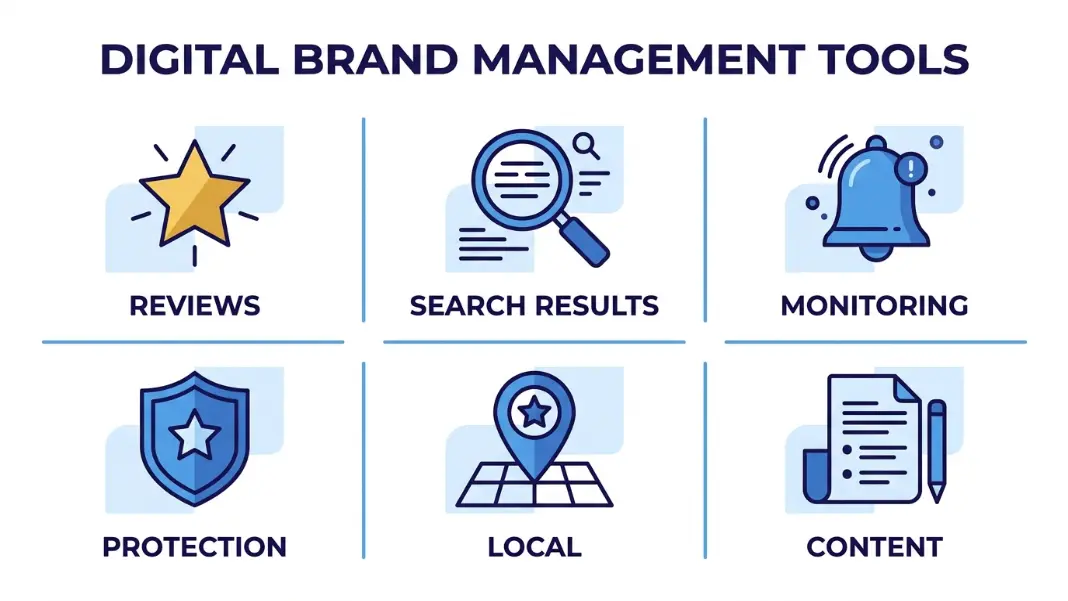
Here is what professional ORM agencies actually deliver:
| Service | What It Does | Platforms Covered |
|---|---|---|
| Review Generation | Automates post-service review requests via SMS and email | Google, Yelp, Facebook |
| Review Monitoring | Alerts you to new reviews in real time for fast response | All major review platforms |
| Search Engine Reputation Management | Pushes negative search results down using SEO and content | Google, Bing |
| Brand and Social Monitoring | Tracks every web mention of your business name | Social, news, forums |
| Negative Content Suppression | Removes or buries harmful content through strategic SEO | Google Search |
| Local Search Reputation | Optimizes Map Pack presence via GBP management and reviews | Google Maps, Apple Maps |
| Crisis Response | Structured plan for public complaints and negative press | All channels |
Review Generation and Review Monitoring
Reviews drive purchasing decisions in ways most businesses underestimate. When someone is choosing between two HVAC contractors or two dental practices, they read reviews first. A business with 180 reviews averaging 4.7 stars will consistently win that comparison over a competitor with 25 reviews at 4.4 stars, regardless of which company is actually better at the work.
Review generation services build a consistent flow of genuine new reviews through automated follow-up sequences sent after completed jobs or appointments: SMS requests, email follow-ups, and direct links to the review platform that matters most for your industry. The emphasis is on making it easy for satisfied customers to leave feedback, because most of them will not do it without a prompt.
Review monitoring runs alongside generation. A monitoring system tracks new reviews across Google, Yelp, Facebook, and any industry-specific platforms relevant to your business. It alerts you when something new appears so you can respond quickly. Responding to a negative review within 24 hours, publicly and professionally, reduces the damage significantly compared to leaving it unanswered for weeks.
Search Engine Reputation Management
Search engine reputation management is the SEO-specific branch of ORM. It focuses on controlling what fills page one of Google when someone searches your business name, your personal name, or your product.
When a negative news article, a Glassdoor complaint, or a forum post ranks on page one for your brand name, every prospective customer sees it before they see anything you control. SERM uses content creation, link building, and technical SEO to push those results down and replace them with content you manage: your website, your social profiles, press coverage, and positive third-party mentions.
This is technically demanding work, and it is where genuine SEO expertise matters. Ranking your own pages and profiles above damaging third-party content requires real search engine optimization applied to branded search terms, not just submitting a content removal request.
Brand and Social Media Monitoring
Brand monitoring tracks every mention of your business name across the web, whether or not you were tagged. That includes social media, news sites, forums, blogs, and review platforms.
Most businesses discover damaging content weeks or months after it appears, by which point the search visibility damage is already accumulating. Monitoring services catch these mentions in real time so you can respond, address, or escalate before the content gains traction and potentially ranks.
Social media reputation management also covers your active presence: making sure profiles are complete, consistent, and regularly updated, and that comments and direct messages receive timely responses that reflect well on the business.
Negative Content Suppression and Removal
Some negative content can be removed directly. Reviews that violate platform policies, factually false statements, or outdated information can sometimes be disputed or legally requested for removal. Google's legal removal tools and individual platform policies each have specific criteria that need to be met.
When removal is not possible, suppression is the next option. This means creating and optimizing multiple pieces of positive content so that the negative result drops to page two or three, where fewer than one percent of search users ever look. Suppression is a long game. Moving one entrenched piece of negative content typically takes three to nine months of consistent, strategic work.
Local Search Reputation Management
For service businesses with a local customer base, how you appear in the local Map Pack matters as much as your website. Those three business listings that appear with a map at the top of search results are seen by nearly every person searching for a local service, and your placement there is influenced significantly by review count, review recency, and how actively you manage your Google Business Profile.
Local SEO and reputation management are deeply connected. Agencies that handle both can align your review strategy with your Map Pack rankings, because they pull from the same signals. A business with 200 recent reviews and active response management will consistently outrank a competitor with 30 stale reviews and no responses, even with a comparable website.
Reputation Content Creation
Part of managing your reputation is creating content you control that ranks for branded and category searches. This typically includes blog posts and articles that associate your business with relevant expertise, press mentions on third-party sites with high authority, video content that indexes for your business name on YouTube, and case studies that add visible credibility.
Content marketing is the long-term foundation of reputation building. It creates a body of authoritative, positive content that is indexed by Google, referenced by AI tools like Google AI Overviews and Perplexity, and cited in direct answers when someone asks a question about your category.
Crisis Response and Reputation Repair
When something goes wrong, the speed and quality of your response determines how much lasting damage it causes. A viral complaint, a critical news story, a former employee's public post: all of these situations compound quickly if not managed.
Crisis management services provide a structured response plan, help draft public statements, coordinate outreach to affected parties, and begin the suppression and content work needed to limit the long-term search impact. Most businesses without a plan in place lose weeks reacting when they should be managing.
Who Actually Needs Reputation Management Services?
Service businesses with high-consideration purchases. When someone is choosing an HVAC contractor, a law firm, a dental practice, or a moving company, they research before deciding. If what they find during that research is negative, unmanaged, or thin, they move on. ORM is most critical in industries where the cost of the service and the trust required are both high.
Small businesses with few reviews. The fewer reviews you have, the more impact each individual review carries. A business with 12 reviews and one angry customer can drop from 4.8 stars to 4.1 stars overnight. Building review volume creates resilience against that kind of damage.
Professionals in trust-sensitive fields. Doctors, attorneys, financial advisors, and consultants are regularly searched by name before an appointment. Personal reputation management focuses on what appears for your name specifically, covering professional directory profiles, LinkedIn, news mentions, and any other sources that rank for your name.
Businesses that have been through a negative event. A competitor campaign, a negative news story, a former employee's public complaint: these situations do not self-resolve. Without active management, a piece of negative content can stay on page one of Google for years while your competitors who never had the problem maintain clean search results.
How Search Engine Reputation Management Works
When someone searches your business name, Google decides what to show based on relevance, authority, and entity signals. If a review site, forum post, or news article has more links pointing to it and more engagement than your own pages, it ranks above your website. That is not a bug in how Google works. It is how relevance scoring functions.
SERM changes the competitive equation around your branded search terms.
The process begins with an audit. A qualified agency documents every result on pages one and two for your business name, your personal name if relevant, and common name variations. Each result is categorized: controlled (your website, social profiles), positive third-party (press, positive review sites), neutral (directories with accurate basic information), and harmful (content you want pushed down).
From there, a suppression plan targets the harmful results through specific strategies:
- Creating and optimizing new pages and profiles that can outrank the harmful content
- Building authoritative backlinks to the positive pages you control
- Publishing third-party content on sites with higher domain authority than the damaging results
- Optimizing your existing web pages to rank more strongly for branded searches
- Establishing consistent entity signals across directories, social profiles, and structured data
This is the same technical work as search engine optimization, applied to branded terms rather than category keywords. The timelines are similar: meaningful search result movement typically starts at 60 to 90 days, with significant displacement of negative results around six months of consistent execution.
What Results Can You Realistically Expect?
Realistic expectations matter, because the reputation management industry has a history of agencies overpromising.
What a qualified agency can deliver:
A measurable increase in review count and average star rating within 30 to 60 days of launching a review generation program, provided your customers are being systematically contacted after service. Monitoring and response systems go live within the first week of engagement. Search result movement for brand name searches begins within 60 to 90 days and becomes meaningful at three to six months. Monthly reporting should show exactly what changed: which results moved, how many reviews were generated, what was published, and what is coming next.
What no agency can guarantee: the complete removal of all negative content, a specific star rating by a specific date, or guaranteed ranking positions. Search engines and review platforms operate independently of any agency's promises.
If a firm is guaranteeing you specific results on a short timeline, that is worth scrutinizing carefully before signing anything.
How to Choose a Reputation Management Agency
Look for agencies that start with an audit. Before recommending anything or quoting a price, a qualified agency will document your current reputation: what ranks for your name, your review counts by platform, your current star rating, and where the gaps are. Agencies that skip this step and go straight to a proposal are guessing at your situation.
Ask for a defined scope of work. Reputation management can mean five different things to five different agencies. A clear written scope that specifies which services are included, which platforms are covered, and how performance will be measured tells you what you are buying. Vague commitments to "improve your online presence" tell you nothing.
Check how they report. Monthly reports should show outcomes: review count changes, star rating movement, search result changes, published content. Not hours logged or tasks completed. If an agency cannot show you what moved last month in concrete terms, they likely cannot explain it because nothing moved.
Understand their methods. Agencies that promise to "delete" or "remove" all negative reviews are either misinformed or misleading. Legitimate removal is possible in specific cases, but it is not a bulk service. Suppression through content and SEO work is more realistic and more durable.
Match industry experience to your situation. A dental practice has different platform priorities than a contractor or an e-commerce brand. An agency with experience in your specific industry understands which review platforms drive decisions, how competitive the search results are for your category, and what content types perform best for your audience.
Our reputation management service starts with a documented audit of your current digital footprint, covers review generation, monitoring, SERM, and content creation, and reports monthly on what changed and what is next.