Social Media for Local Service Businesses: What Books Jobs
The Problem With "Just Post on Social Media"
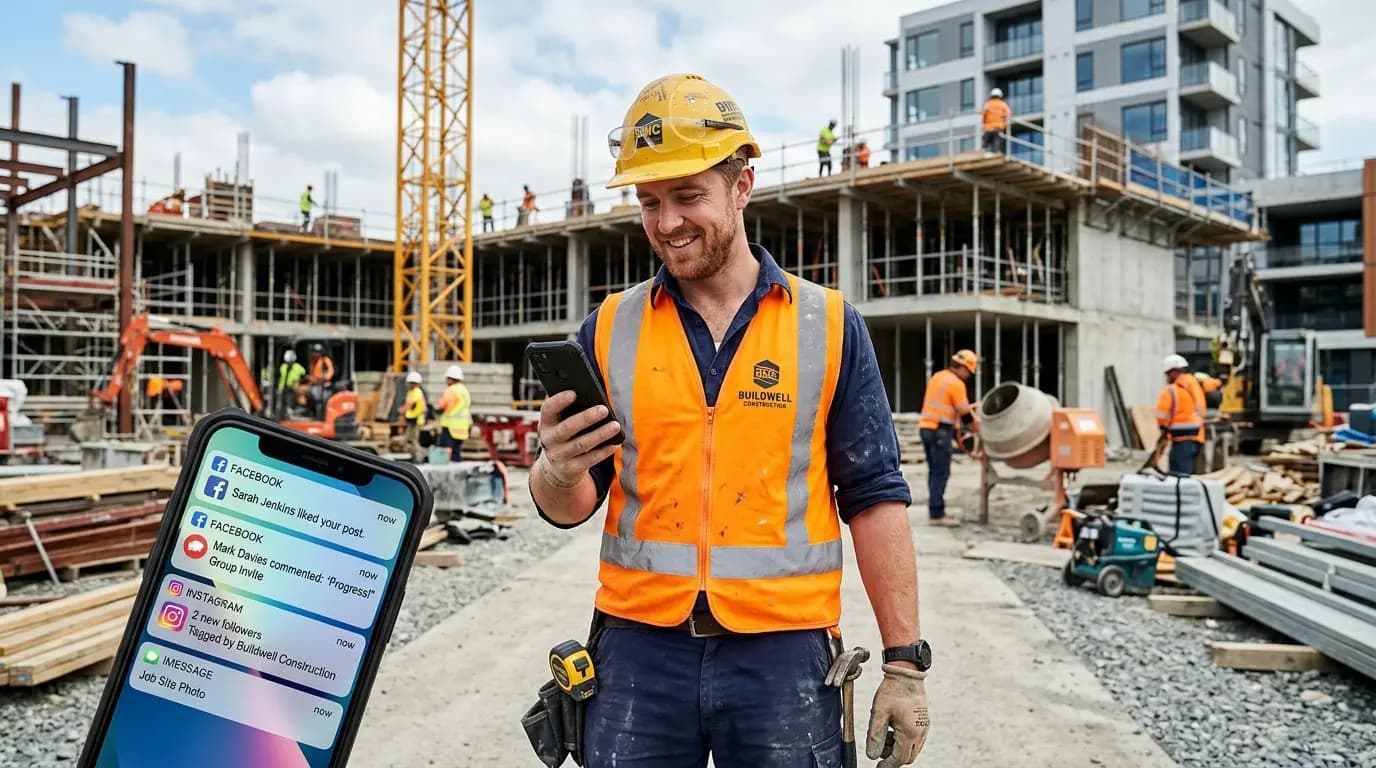
A plumbing company had 1,400 Facebook followers. They posted three times a week: job site photos, team birthdays, the occasional tip about a slow drain. Engagement was decent. Their phone did not ring because of it.
That is the most common outcome for local service businesses investing time in social media without understanding what the channel actually does and does not do.
Social media is not a direct lead generation channel for most local service contractors in the US. The businesses that understand this clearly produce a better return than the ones treating Facebook like a digital Yellow Pages. The ones who misunderstand it spend two hours a week posting and wonder why calls are not coming.
This guide covers what social media actually does in the local service customer journey, which platforms produce results by trade type, why Nextdoor outperforms Facebook for residential referrals in most markets, and what content you should post to support real business growth.
Social Media's Real Job in the Customer Decision Path
Here is the path most residential service customers take before they call a contractor:
- A neighbor mentions your business, sees your truck in the driveway, or finds you through a Google search.
- They search your business name directly.
- Google pulls your Business Profile. They check your rating and reviews.
- Then they check your Facebook or Instagram to see if you are still active and if the work looks legitimate.
- If the last post was seven months ago, some of them bounce to a competitor. If they see a completed job from last week, they call.
Social media in this path is a trust verification layer. Your customer found you through a referral or a search. Social media is what they check to confirm you are real, active, and worth a call.
That reframe matters because it changes how you evaluate every decision about what to post. You are not trying to interrupt someone's scroll and make them decide right now to hire an HVAC company. You are showing evidence of recent work to someone who is already considering calling you.
The bar for "good social media" for a local service business is not viral reach or follower count. It is a profile that confirms trust when someone who is already warm checks it.
Which Social Media Platform Works Best for Your Trade?
The answer is not "Facebook" for every contractor. Platform performance for local service businesses varies significantly by trade, service model, and the demographic of the homeowners you serve.
| Trade | Best Platform | Why | Secondary Platform |
|---|---|---|---|
| HVAC | Facebook + Instagram | Seasonal content timing, homeowner demographic skews 35 to 65, equipment install visuals | Nextdoor for neighborhood referral reach |
| Plumbing | Facebook + Nextdoor | Emergency response speed, referral-heavy model, homeowner recommendation requests | None — spreading thin reduces impact |
| Roofing | Instagram + Nextdoor | Before/after visual impact, storm-season response content, neighbor-to-neighbor referrals | Facebook for paid local ad reach |
| Landscaping | Instagram + Facebook | High visual output, seasonal project content, property transformation | Pinterest for design-focused homeowners |
| Pest Control | Nextdoor + Facebook | Neighborhood outbreak posts, seasonal urgency, strong local referral culture | None |
| Cleaning Services | Instagram + Facebook | Interior before/after photos, recurring client testimonials, visual quality signals | Nextdoor for neighborhood recommendations |
| Auto Repair | Local community focus, service update posts, older demographic | Google Business Profile is the higher priority |
The pattern: trades with high visual output — roofing, landscaping, cleaning, interior work — produce more from Instagram because before/after content performs naturally there. Trades with an emergency or referral-heavy model — plumbing, pest control — get more from Nextdoor and Facebook because those platforms match how homeowners search for and recommend urgent services.
TikTok is worth considering for trades targeting younger homeowners — first-time buyers in the 25 to 40 range — but for most service businesses in 2026, the time investment does not produce a proportional return unless someone on the team enjoys creating short video content as part of the job.
For HVAC social media management, the platform mix looks very different from social media for plumbing companies. Generic "use Facebook for everything" advice collapses these distinctions in a way that makes every recommendation less useful.
Why Is Nextdoor the Most Underrated Platform for Home Services?
Nextdoor is the platform local service businesses consistently underestimate. Most agencies barely mention it. The reasoning is circular: "our clients get fewer Nextdoor leads than Facebook leads." The cause is almost always that three times more effort goes into Facebook.
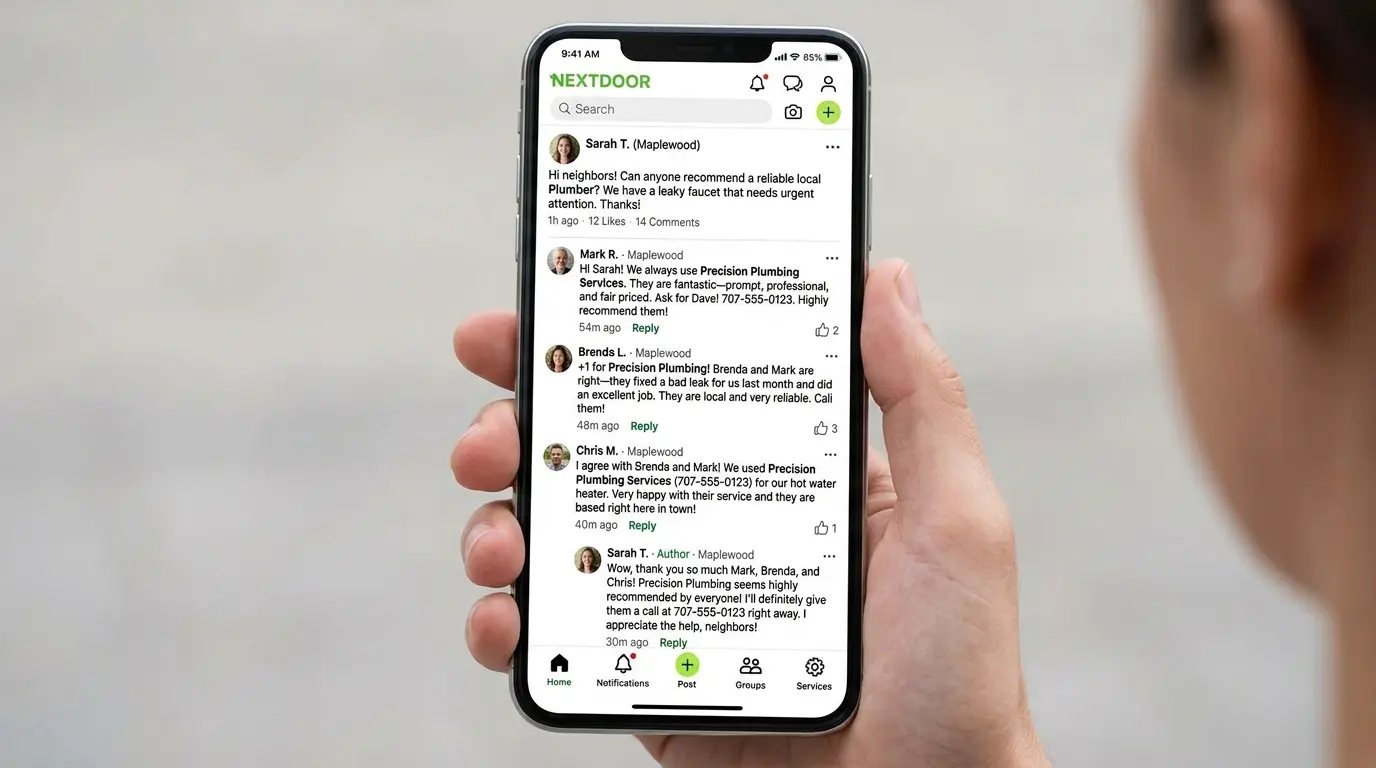
Nextdoor's structural advantage is intent. A homeowner asking for a plumber recommendation on Nextdoor is not passively scrolling. They are actively requesting a referral from neighbors who have first-hand experience. According to Nextdoor's platform data, 67 percent of users share local business recommendations, and home services is the most recommended category on the platform.
A Facebook ad interrupts a scroll. A Nextdoor recommendation answers an active question.
The setup that produces results: claim your business page on Nextdoor, respond to every mention or recommendation request in your service area within the hour, and ask satisfied customers specifically to post a recommendation on Nextdoor (not just Google). A single positive Nextdoor recommendation in a dense residential neighborhood can drive referral calls from that area for six to twelve months after it is posted.
Pest control companies see this dynamic most clearly. A single "had a great experience with [company]" post after a seasonal mosquito or ant surge generates call volume that paid Facebook ads in the same zip code rarely match at the same cost.
Organic vs. Paid: What Does Social Media Actually Cost?
Organic social media — free posting — for a service business with under 2,000 followers reaches a small fraction of its audience. Facebook's organic reach for business pages has declined for years. Most posts reach 3 to 5 percent of followers without paid promotion. For a page with 800 followers, that is 24 to 40 people per post.
That is not a lead generation strategy. It is a trust maintenance strategy. Which is exactly the role described above.
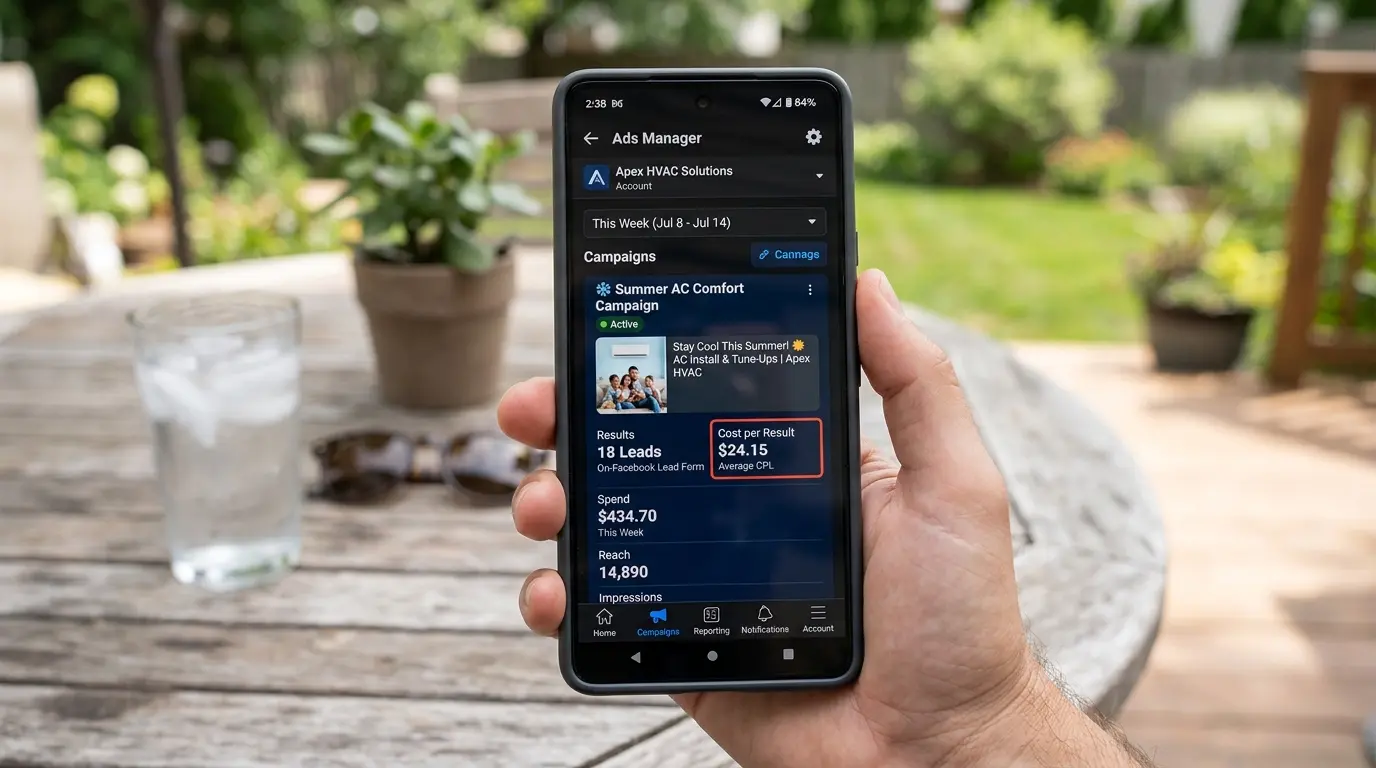
Paid social — Facebook and Instagram ads — produces measurable lead volume when campaigns are structured correctly. According to LocaliQ industry benchmarks, the average Facebook cost per lead for US home services businesses sits around $27. That figure varies significantly by trade and by season.
Roofing companies running ads immediately after a hailstorm can see Facebook CPLs drop to $8 to $12 because demand is already elevated and homeowners are actively seeking solutions. The same campaign in a non-storm market costs $35 to $50 per lead. Knowing when to spend is as important as knowing how.
Google Ads typically produces higher-intent leads than Facebook Ads for most service trades because it captures active demand — someone searching "emergency AC repair now" — rather than creating demand from passive scrollers. The two channels work together rather than competing: Google captures people actively searching, Facebook retargets those who visited the website but did not call. Running both channels together produces a more complete pipeline than either alone.
If you want a detailed breakdown of what paid search actually costs for your specific trade, the cost benchmarks across nine service industries covers the numbers in full.
The Seasonal Playbook: When Social Media ROI Spikes
Social media return for home service businesses is not flat throughout the year. It spikes during weather events and demand peaks. The contractors who prepare for these windows in advance produce dramatically better results than those reacting after the opportunity has already peaked.
For roofing companies: Set up Facebook and Instagram ad campaigns before storm season with creative assets ready but campaigns paused. When a hail event hits your market, activate within 24 hours. Facebook's ad auction becomes more favorable for roofing in post-storm markets because homeowners are actively searching rather than waiting to be persuaded. Have Nextdoor posts ready for neighborhood-level communication as well — storm damage is inherently local, and Nextdoor's geographic targeting is the right channel for it.
For HVAC companies: The two high-value windows are April through June for AC season prep and September through November for heating system checks. Social content pushing maintenance reminders and seasonal tune-up offers 3 to 4 weeks before these windows builds the audience that converts when the season peaks. Waiting until the season is underway means competing in a more crowded ad auction at higher costs.
For plumbers: Freeze weather events are the short-window equivalent of storm season for roofers. Having a "frozen pipe emergency" content piece and ad set ready to activate immediately when freeze warnings hit is the difference between capturing a surge and watching competitors take it. The window is narrow. Pre-built assets make it possible to respond in hours rather than days.
This seasonal approach is consistent with what Nextvure applies across HVAC marketing and plumbing marketing programs. Businesses that pre-build their content and campaign assets for known demand periods outperform those reacting in real time, because real-time reaction usually happens 48 hours after the peak has already begun.
What to Post: The Content That Confirms Trust
Since social media's primary function for local service businesses is trust confirmation, the content that performs best provides evidence of real work and real client outcomes. A homeowner scrolling your profile is looking for three things: proof you do good work, proof you are still active, and proof other real people have hired you.
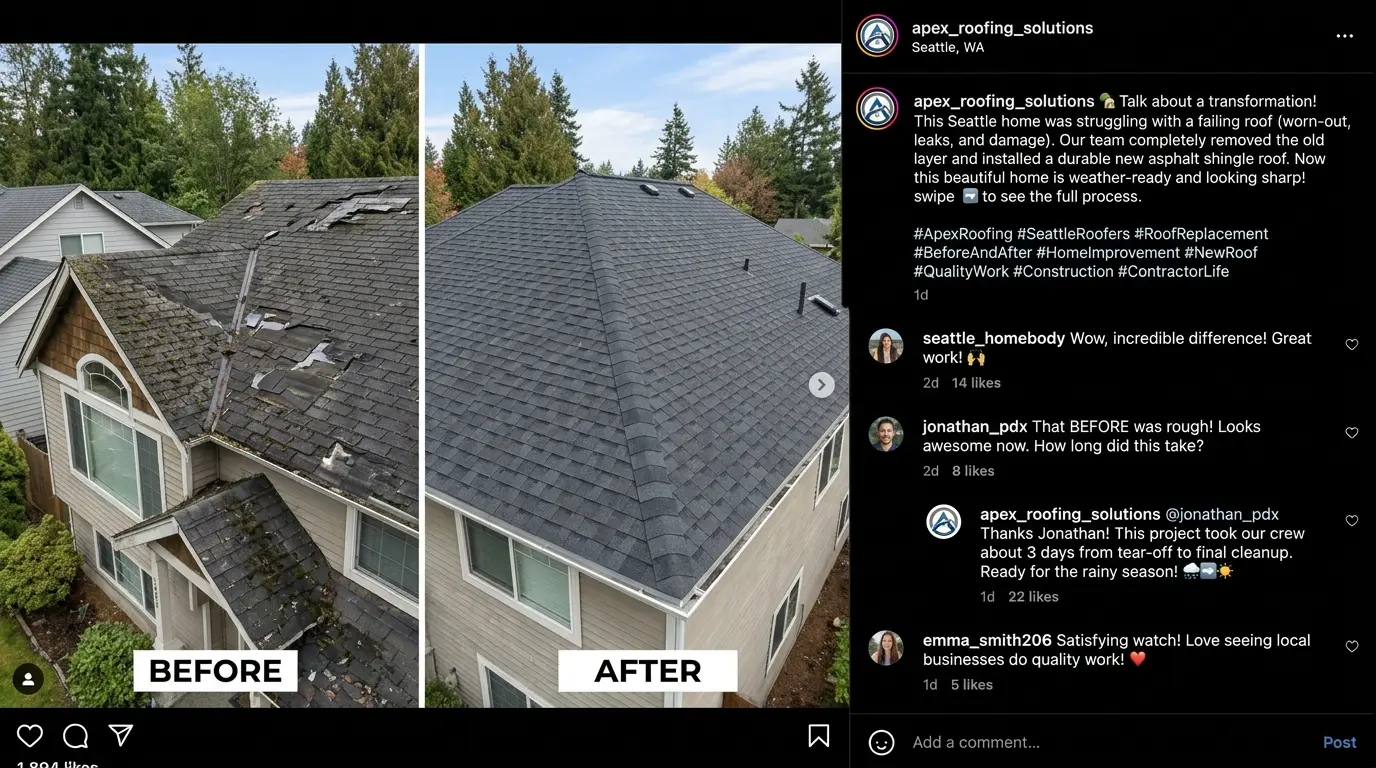
Before and after job photos are the highest-performing organic content type for trades with visual output. A before photo of a damaged roof and an after photo of the completed installation tells the full story without a caption. These posts generate saves and shares at higher rates than any other format. They also give a prospective client the portfolio evidence they want without having to ask.
Completed job documentation — a photo of the finished work, the neighborhood (not the specific address), and a brief description of what was done — builds a visible track record on your social profile over time. An HVAC company with 40 completed job posts over the past year demonstrates consistent activity in a way that a few generic posts never will.
Team and company culture posts perform better than most service businesses expect. A photo of the technician with the homeowner after a satisfying job, a training certification announcement, or a milestone like "10 years in business" signals stability and trustworthiness. People hire service businesses they feel comfortable letting into their home. Evidence of a real, stable team reduces that hesitation.
Customer reviews reposted as graphics bridge your reputation management and social channels. A Google review screenshot or a designed review card posted to Instagram confirms that other real people have vouched for the business. This content does double duty: it builds trust on social and reinforces the relevance of the reviews platform where the review originally lived.
The 5-Minute Response Rule for Social Media Inquiries
Here is where a significant portion of social media leads go cold, and almost no social media advice for contractors addresses it.
When a potential customer comments on a post, sends a Facebook message, or replies to an Instagram Story asking about pricing or availability, the window to respond before they contact another contractor is short. Research from MIT cited by HubSpot shows that responding to an inquiry within five minutes is 100 times more effective at maintaining contact than a response at 30 minutes. At the two-hour mark, the lead has almost always found another option.
Most service business owners are on job sites. They check Facebook when they remember to. Inquiries sit for hours. The lead is gone.
The practical fix does not require constant phone monitoring. Facebook Messenger's auto-response feature sends an automated acknowledgment that confirms receipt, gives a call-back window, and provides a phone number for faster contact. This is not a bot replacing a conversation. It is a message that says "we got your inquiry and will call you in the next two hours" — which keeps the lead from immediately contacting your competitor while you are finishing a job.
If your business uses a CRM or a lead generation system with automated follow-up, connecting social media inquiries into the same rapid-response pipeline as form submissions and phone calls is where the conversion improvement becomes most significant.
What Social Media Can and Cannot Do for Your Business
Social media does not book the job. The phone call books the job. The estimate that follows books the job. The Google review that made the homeowner pick up the phone in the first place books the job.
Social media is what makes the homeowner confident enough to call instead of clicking to the next search result.
That is a real and meaningful role. It is just not the role that most social media advice for contractors describes. If your reputation management is strong, your Google Business Profile is complete, and your social profiles show recent real work, social media becomes the confirmation layer that closes the trust gap. If those other elements are weak, more social posts are not going to compensate.
Build the foundation. Use social media to protect and extend it.
Nextvure offers a free audit that maps every channel — search, reputation, paid, and social — against your current lead volume and identifies where the gaps actually are. Request the audit here and get a specific answer for your trade and your market.