What Is Reputation Monitoring? How Service Businesses Track and Protect Their Online Presence

The Review That Was Already Three Weeks Old
A pest control company owner checks Google reviews on a Thursday afternoon. There is a one-star review from a customer who described a missed appointment and no follow-up call. The review has 47 words. It has been sitting there for 21 days.
In those 21 days, the review was visible to every person who searched the company name. Some of those people searched because they were about to book. Several of them probably chose a competitor instead.
The owner had no idea the review existed until a slow Thursday gave him time to look.
That is the problem reputation monitoring solves.
What Is Reputation Monitoring?
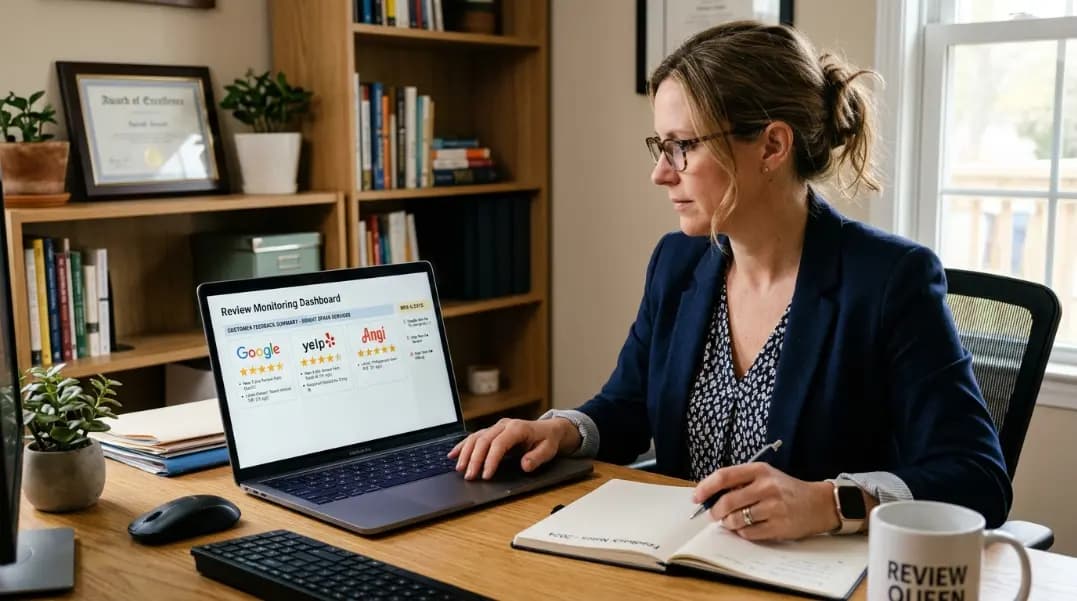
Reputation monitoring is the ongoing process of tracking what is said about your business across every platform where customers, competitors, and third parties post public content about it. The goal is to know what is being said as close to when it is said as possible, so that a problem review does not sit unanswered for three weeks and a misinformation post does not go uncorrected for a month.
For service businesses, reputation monitoring is not a one-time audit. It is a system that runs continuously in the background, surfacing new mentions, reviews, ratings changes, and directory updates so the business can respond, correct, or escalate when needed.
The distinction between monitoring and reaction is the entire value. A business that monitors reputation acts while the problem is contained. A business without monitoring reacts after the damage is done.
Reputation management services for service businesses build this monitoring layer as the foundation before any review generation or response strategy is layered on top.
What Does Reputation Monitoring Track?
Monitoring covers five categories of online signals that affect how customers and search engines evaluate a service business.
Review Platforms
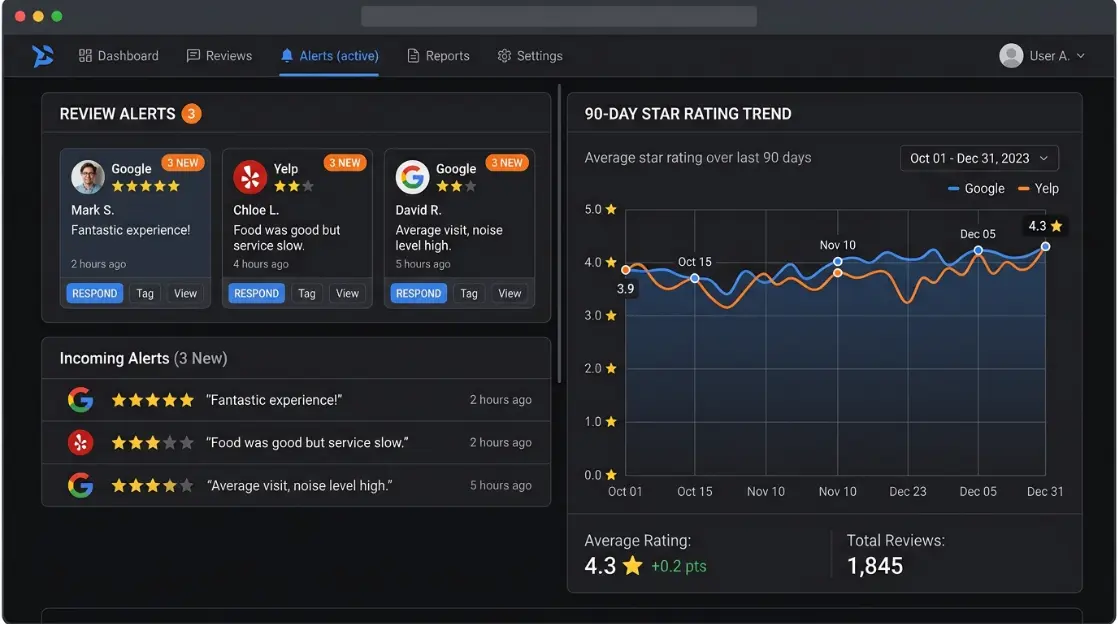
Google Business Profile, Yelp, Facebook, HomeAdvisor, Angi, Houzz, Thumbtack, and industry-specific directories all collect customer reviews independently. A new one-star review on Yelp does not trigger a notification on Google. Without a monitoring system that aggregates across platforms, reviews on secondary sites can sit unanswered for months.
Monitoring tracks new reviews as they appear, rating changes, and owner response status across all platforms where the business is listed.
Branded Search Results
When someone searches your business name, the results they see are part of your reputation. A negative article, a competitor comparison page, or a forum thread can appear in position two or three for your brand name and influence buying decisions before a customer ever visits your website.
Reputation monitoring includes tracking what appears in branded search results so that content requiring a response or suppression strategy is identified early.
Social Media Mentions
Customers post about service experiences on Facebook, Instagram, Nextdoor, Reddit, and X without tagging the business. Those posts are visible to the poster's entire network and, in the case of neighborhood platforms like Nextdoor, to an entire geographic community.
Monitoring tools track mentions of the business name, common misspellings, and associated keywords across social platforms so that positive conversations can be acknowledged and negative ones can be addressed before they spread.
Directory Listings Accuracy
Incorrect business information in directories and data aggregators damages reputation in two ways: it erodes customer trust when the phone number or address is wrong, and it creates inconsistency signals that reduce local search rankings.
Monitoring tracks the accuracy of name, address, phone number, and category data across the 50 to 80 directories that feed local search engines, flagging any listings where the data has drifted from the correct version.
Competitor Review Activity
Understanding where competitors are gaining or losing reputation signal informs strategy. If a direct competitor is accumulating five-star reviews on Google while your volume stalls, that shift in rating differential affects how Google ranks both businesses in the map pack.
Monitoring competitor review volume and rating trends gives early warning when the competitive reputation gap is widening.
How Reputation Monitoring Differs From Review Management
These two terms are often used interchangeably. They describe different functions.
| Reputation Monitoring | Review Management | |
|---|---|---|
| What it does | Tracks all mentions and reviews across platforms as they appear | Actively generates new reviews and responds to existing ones |
| Timing | Continuous, real-time alerts | Triggered by new content or scheduled campaigns |
| Platforms covered | Reviews, search, social, directories, news | Primarily Google, Yelp, Facebook |
| Primary output | Alerts and trend data | New review volume and response activity |
| Goal | Know what is being said as soon as it is said | Improve rating and review count over time |
Review management without monitoring is like publishing new content without checking whether old content has problems. The generation activity looks productive, but uncaught negative content undermines the results.
The guide to online review management for service businesses covers the review generation and response side of the equation. Monitoring is what makes both of those activities effective by ensuring nothing gets missed between cycles.
What Fast Monitoring Enables
The value of reputation monitoring is response speed. Speed matters because most platforms display reviews chronologically and because search engines treat unanswered negative reviews differently than reviews with an owner response.
Here is what a monitoring system with real-time or near-real-time alerting enables:
Response within the platform's window: Google and Yelp both factor owner responsiveness into how reviews are displayed. A review answered within 24 hours signals an active business. A review answered 21 days later signals the opposite.
Customer recovery before the damage compounds: A one-star review from a customer with a genuine complaint is often recoverable with a direct call and a service correction. That recovery window closes as time passes. By day 21, the customer has already told their neighbors, found another provider, and moved on.
Catch misinformation early: Incorrect information about your business, whether posted by a disgruntled former employee or a competitor, is easiest to address within the first 48 to 72 hours before it earns social shares or search indexing.
Track rating trend before it becomes a crisis: A business sitting at 4.6 stars does not become a 4.1-star business overnight. It drops one review at a time. Monitoring the trend rather than just the current number gives visibility into whether the trajectory is up, flat, or declining before the drop is deep enough to affect search rankings.
Industry Benchmarks: What Good Looks Like
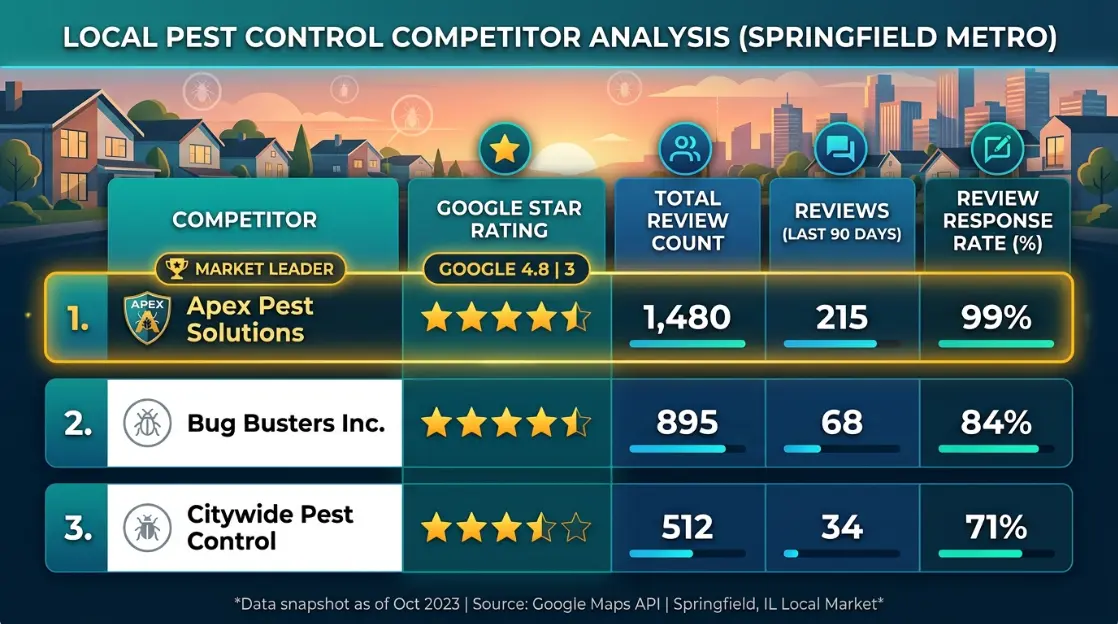
Reputation health benchmarks vary by industry. A pest control company competing in a suburban market has a different competitive baseline than a law firm in a major metro. The relevant question is not whether your rating is good in absolute terms, but whether it is competitive in your specific market.
| Industry | Competitive Floor (Star Rating) | Review Freshness Window | Response Rate Expectation |
|---|---|---|---|
| Pest Control | 4.4+ | Reviews within 90 days | 90%+ of all reviews |
| HVAC | 4.5+ | Reviews within 60 days | 85%+ of all reviews |
| Plumbing | 4.3+ | Reviews within 90 days | 80%+ of all reviews |
| Dental | 4.6+ | Reviews within 30 days | 95%+ of all reviews |
| Legal | 4.5+ | Reviews within 60 days | 90%+ of all reviews |
| Landscaping | 4.2+ | Reviews within 120 days | 75%+ of all reviews |
These are market-floor thresholds, not targets. The goal is to stay above the floor while working toward the top of the range in your category and geography.
A monitoring system surfaces the data that tells you where you sit relative to these benchmarks and alerts you when a trend is pushing you below the competitive floor.
Who Needs a Monitoring Service Versus a Self-Managed Tool
Self-managed reputation monitoring tools exist. Google Alerts, Mention, ReviewTrackers, and Podium all offer dashboard monitoring for businesses that have someone internally to manage it. The question is not whether tools are available, it is whether the business has the bandwidth and expertise to act on what those tools surface.
A self-managed monitoring setup works when the business has a designated person checking the dashboard daily, the SEO knowledge to evaluate branded search results and understand when a suppression strategy is needed, the process to respond to reviews on every platform consistently, and the capacity to track directory accuracy across 50-plus listings.
Most service businesses with fewer than 20 employees do not have all four of those conditions in place. The monitoring tool gets set up, runs for 30 days, and then gets ignored when the next busy season starts.
A managed reputation management service handles the monitoring infrastructure, surfaces only what requires owner input, and executes the response and correction activity that self-managed setups require someone internally to do.
The local growth framework for service businesses covers how reputation monitoring integrates with local SEO and directory management as a combined signal system that affects search rankings, not just customer perception.
For context on the full scope of what online reputation management covers beyond monitoring alone, the guide to online reputation management services outlines the complete strategy.
Know Before the Damage Compounds
Reputation monitoring is not a defensive posture. It is the intelligence layer that makes every other reputation activity, including review generation, response strategy, and directory management, actually work.
Without monitoring, review generation is blind. You are adding new five-star reviews without knowing whether a two-star review posted three weeks ago is offsetting them. Without monitoring, response strategy is reactive at best. You answer reviews you happen to notice rather than every review that a potential customer might read.
The businesses that maintain a 4.7-star rating in competitive markets are not doing more marketing. They are operating with more visibility into what customers are saying and acting on it faster than competitors who find out weeks later.
If you want to understand what a monitoring setup looks like for your specific market and service category, talk to Nextvure about a reputation audit. The first step is knowing what is already out there.